

Duplicate invoices: how AI agents catch and clear them

A duplicate invoice is a second bill for spend a supplier has already invoiced, arriving as an exact copy or a near-copy with a changed number, shifted date, or restated total. Among invoice exceptions, duplicate invoices carry an unusual risk: most exceptions delay a payment, while a duplicate that clears gets paid, and the company pays twice for one delivery. Duplicate detection is the control that stops the second copy before it posts.
This wiki defines source-to-pay terms for companies where AI agents do the operational work – capturing invoices, checking history, clearing holds – and people keep the judgment calls. Most glossaries treat duplicate checking as a database lookup; this page treats it as an investigation an agent runs, because a lookup by itself misses disguised duplicates and blocks legitimate charges that resemble them.
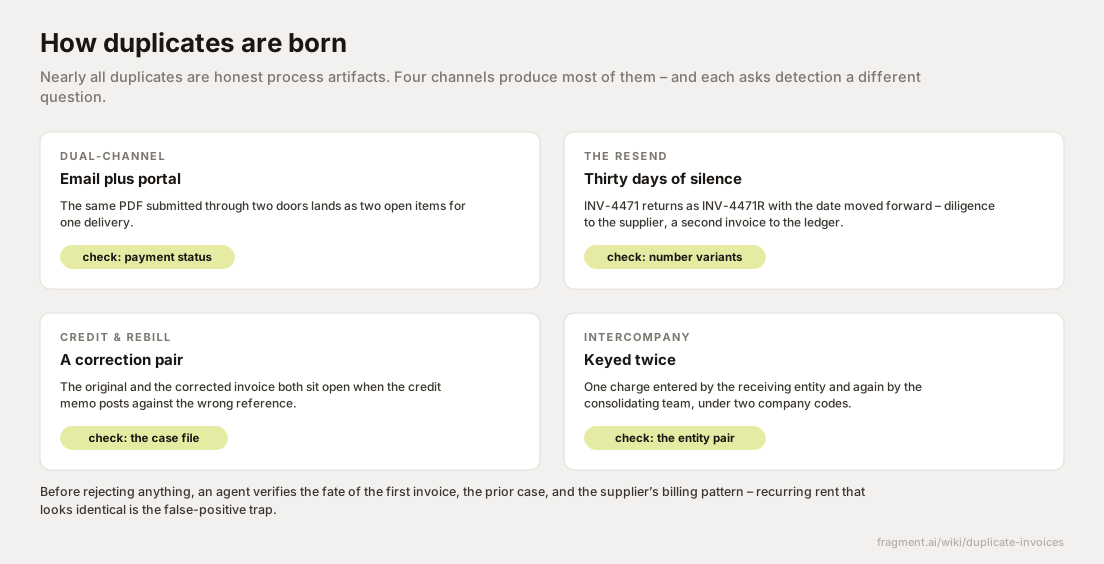
Duplicate invoices are born in ordinary process gaps
Nearly all duplicates are honest process artifacts; four channels produce most of them.
- Dual-channel submission. A supplier emails a PDF to the AP inbox and, a week later, uploads the same document to the Ariba portal because the portal shows nothing received. Both copies get captured, and SAP carries two open items for the same $18,250 of machined parts under INV-4471.
- The resend after silence. A supplier who hears nothing for 30 days assumes the invoice was lost and submits it again, usually with the date moved forward and sometimes a suffix added, so INV-4471 returns as INV-4471R dated a month later. To the supplier this is diligence; on the ledger it is a second invoice.
- Credit-and-rebill pairs. A supplier who billed the wrong amount issues a credit memo cancelling the original, then a corrected invoice. When the credit memo is delayed or posted against the wrong reference, the original and the rebill both sit open, and each looks like a duplicate of the other.
- Intercompany billing. When one subsidiary charges another through a shared-services center, the same charge is sometimes keyed by the receiving entity and again by the consolidating team, so it lands under two company codes and surfaces twice at close.
The types of invoice exceptions page catalogs the other failure modes. Duplicates stand apart because the second document is usually flawless on its face – valid supplier, valid PO reference, correct math – and the defect exists only in relation to history.
An agent matches in layers, from exact to fuzzy
Catching duplicate invoices starts with the check most ERPs already run: an exact match on supplier, invoice number, and amount. SAP's standard duplicate check works this way, and it reliably stops the same PDF captured twice. It stops little else: change one character of the number and INV-4471R sails past a rule keyed to INV-4471.
An agent adds two layers. The first is fuzzy matching on the invoice number. Suppliers and capture tools write the same number many ways – INV-001, INV001, 001, INV_001 – so the agent strips prefixes, suffixes, separators, and leading zeros and matches on what remains. Under that normalization, INV-4471 and INV-4471R collapse to the same key, and the resend surfaces.
The second layer targets the date-shifted resubmission, where the number and the date both change. The agent looks for the shape of the event: same supplier, same total, same line items, issue dates 25 to 40 days apart, first invoice still unpaid. That pattern describes a resend after silence far more often than new spend.
Each layer widens the net, and each widening pulls in more invoices that are legitimately similar. That is where duplicate detection usually breaks.
Recurring charges are the false-positive trap
Many legitimate invoices are near-identical by design. Office rent bills $8,500 on the first of every month. A SaaS subscription invoices $4,150 monthly against a blanket purchase order, a PO covering repeated deliveries across a period. A law firm's retainer arrives for the same amount every month with an invoice number one higher than the last. To the date-shift matcher above, every one is a hit: same supplier, same amount, roughly 30 days apart.
Blocking them does real damage. The landlord's payment stalls, the software vendor's dunning cycle starts (dunning being the escalating sequence of payment reminders), and the account can land on credit hold, so a supplier who billed correctly spends hours proving March's invoice was for March. Do this a few times and the supplier starts calling a buyer directly about every invoice, which pulls the spend outside the process entirely.
The quieter damage is internal. When nine out of ten duplicate flags turn out to be rent and subscriptions, AP clerks learn to release flagged invoices on sight, and the tenth flag, the genuine duplicate, gets released along with them. A detection layer that mostly cries wolf trains its users to override it, which leaves the company worse protected than the plain exact-match check it replaced.
Before rejecting, an agent establishes what happened to the first invoice
What separates an agent from a matcher happens after the flag. Before rejecting anything, an agent verifies three facts.
- The fate of the earlier invoice. The agent pulls the original in the ERP and reads its status: paid, with a clearing document and date; scheduled in a payment run; on hold; or rejected. If the original was rejected over a GL coding error, the new copy is the corrected resubmission the process asked for, and it should post.
- The prior resolution case. If either invoice was investigated before, the case file usually settles the question. A closed case recording that credit memo CM-2210 cancels the original tells the agent the rebill is expected and payable.
- The supplier's billing pattern. Two years of history shows whether the supplier bills a fixed amount on a fixed cadence, whether a contract defines a subscription or retainer, and how invoice numbers move. A sequential number on a monthly cadence reads as recurring spend; an identical or suffixed number against an unpaid original reads as a resend.
Each verified fact maps to a disposition. Recurring charges post without a flag. A confirmed resend is rejected with a note citing the original invoice number, the payment document, and the payment date, so the supplier can close its own open item. A credit-and-rebill pair is matched as a set and posted at net. Ambiguous cases follow the same exception routing rules as any other hold, moving to a person with the evidence attached.
A duplicate that already got paid becomes a recovery decision
One outcome escalates every time. Detection sometimes establishes that the earlier invoice cleared a payment run weeks ago – one copy posted before the pair was checked, or the pair surfaced on a later sweep of history. Rejecting the still-open copy is mechanical. Recovering the money that left is a decision. The company can offset the overpayment against the supplier's next invoices, request repayment, or write off a small amount when chasing it costs more than it returns, and each path carries relationship weight the ledger does not show. An offset can strain a supplier in a tight cash position; a repayment demand can sour a negotiation in progress.
That call stays with a person. What the agent supplies is the finished file: both invoice images, the clearing document for the first payment, the supplier's statement of account, and a recommended path with the reasoning behind it. However the case resolves, a paid duplicate is the most direct entry in the cost of invoice exceptions: cash that went out twice for goods that arrived once.
Fragment builds AI agents that run this sequence inside a company's existing SAP or Ariba environment: layered matching against invoice history, verification of payment status and supplier billing patterns before any rejection, and escalation of paid duplicates with the recovery file already assembled. See how the workflows run or request a demo.