

Exception escalation: what should reach people when agents run the queue

Exception escalation is the handoff of a procurement or AP exception – a blocked invoice, a failed match, a disputed deduction – from the working queue to a person with the standing to decide it. Whether it works turns on two questions: what reaches the team, and in what shape. Get the first wrong and reviewers spend their days on lookup work; get the second wrong and every case restarts its investigation from zero.
Like every page here, this one covers source-to-pay for companies where AI agents carry the operational load – reading contracts, matching documents, chasing confirmations – while people hold the decisions that need a signature or a judgment call. Most glossaries file escalation under workflow, the arrow that moves a case up a tier. This page treats it as a scarce resource, reviewer attention, and sets the rules for spending it.
Exception escalation earns its cost under four criteria
Escalation spends the most expensive attention in the process, so its tests should be narrow and explicit. Four hold up in practice:
- Genuine judgment. The evidence supports two defensible readings. A contract grants an "annual price adjustment" and both parties' readings of which anniversary date applies are reasonable. No further record retrieval settles it; someone has to pick a reading and own it.
- Authority. The evidence is complete and points one way, but policy requires a signature above a threshold: a write-off over $10,000, or a tolerance override – tolerance being the variance band a company accepts before requiring review. The reviewer's job is to confirm rather than investigate.
- Risk. Something in the case pattern-matches to fraud or loss: a bank-detail change arriving alongside a near-duplicate of last month's invoice (see duplicate invoices), or a first-time supplier with nothing on file and a rush payment request. The check is cheap and the mistake is expensive, so the asymmetry alone justifies a person.
- Novelty. No precedent exists, and this decision becomes the precedent. Take the first claim under a clause nobody has ever exercised: whoever decides it is writing policy, whether they mean to or not.
Everything outside these four is a fact-finding problem: the answer exists in some record, and the case needs exception routing to whoever, or whatever, can retrieve it. Most invoice exceptions are exactly that, which is why a well-run escalation path stays quiet.
Under load, teams escalate by dollar value and age instead
The four criteria share an inconvenient property: they can only be applied after someone has investigated the case. Dollar value and age, by contrast, are readable straight off the queue view without opening anything. When volume climbs and staffing stays flat, they become the de facto criteria, and both select the wrong cases.
Dollar value escalates the big mechanical case. A $480,000 invoice carrying a 4% price variance looks alarming until the contract's index-adjustment clause reproduces the invoiced price to the cent – arithmetic, with no judgment anywhere in it. Meanwhile the $3,900 invoice from a supplier registered three weeks ago, with a changed remit-to account, sails under every dollar threshold while hitting the risk criterion squarely.
Age is worse, because queue age measures congestion. The oldest case in a backlog is usually old because it is tedious – a multi-line quantity mismatch spread across four partial deliveries – and tedium is precisely what should never reach a reviewer.
A complete escalation reads like a case file that ends in one question
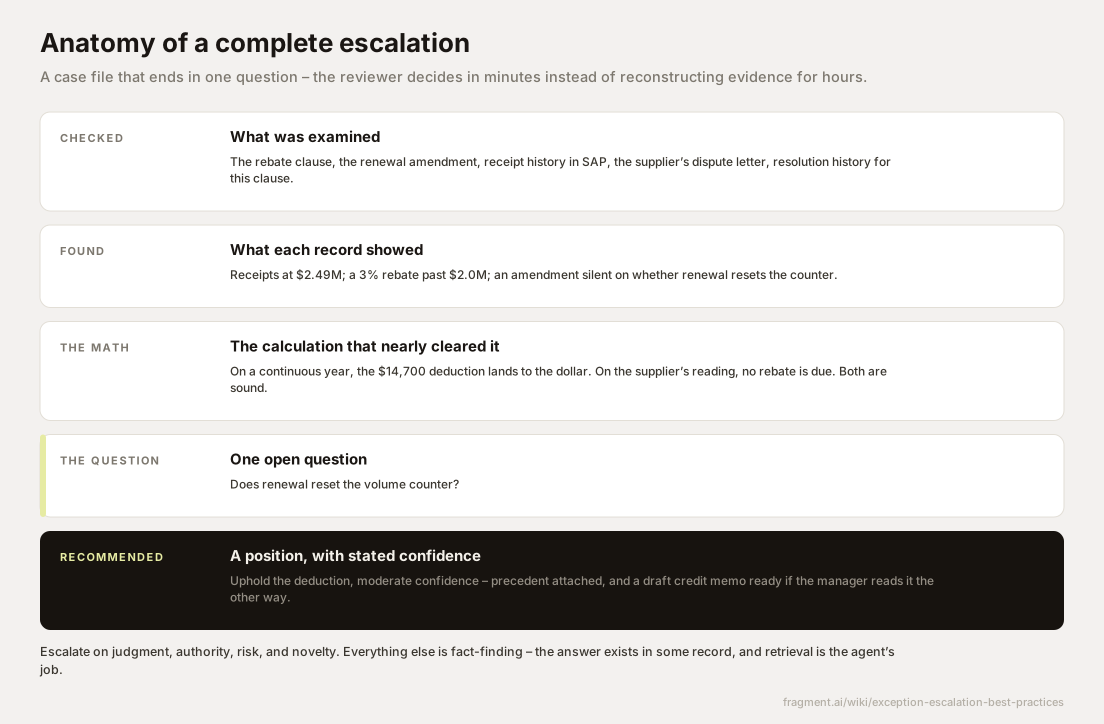
The shape of the handoff matters as much as the selection. A complete escalation carries five things: the checks run, what each record turned up, the calculation that nearly cleared the case, the one question still open, and a recommended action with a stated confidence.
In practice, take a supplier disputing a rebate deduction. The supplier invoices $196,000 for Q2 shipments; AP pays $181,300 after deducting a $14,700 volume rebate – a contractual discount earned once cumulative purchases pass a threshold – and the supplier files a dispute demanding the difference. The escalation that reaches the category manager reads like this:
- Checked: the rebate clause in the 2024 supply agreement, the renewal amendment effective March 1, receipt history in SAP, the supplier's dispute letter, and resolution history for this clause.
- What each showed: the clause grants a 3% rebate on all purchases beyond $2.0M in a contract year. SAP receipts show $2.49M. The amendment renews the agreement and restates the rebate table, and says nothing about whether pre-renewal volume carries over.
- The calculation that nearly cleared it: on a continuous contract year, 3% of the $490,000 above threshold is $14,700 – the deduction to the dollar. On the supplier's reading the counter reset on March 1, post-renewal purchases total $1.62M, and no rebate is due. Both arithmetics are sound, so the numbers cannot settle the case.
- The open question: does renewal reset the volume counter?
- Recommendation: uphold the deduction, moderate confidence. The amendment restates every commercial term except a reset provision, and this supplier accepted a cross-renewal accrual at the 2023 renewal. A draft credit memo for $14,700 is attached in case the manager reads the clause the supplier's way.
The manager decides in minutes, and the decision is recorded against the clause, so the next renewal dispute has precedent. Strip out the workup and the same dispute is a forwarded email chain the manager has to reconstruct from scratch before the judgment part even starts.
Three habits turn escalation into noise
- The hold-code forward. "Line 4 mismatch, see attached." A hold code is the reason label the ERP stamps on a blocked invoice, and forwarding it hands the recipient a symptom plus the entire investigation, so the most senior person in the chain does the grunt work.
- The FYI escalation. A case copied to a manager for visibility, no decision requested. Each one trains reviewers to skim, and eventually the escalation that genuinely needs a decision gets the same skim.
- The everything-escalates failure. When criteria are loose, or the working tier lacks the access or authority to close anything, the queue re-forms one level up as a manager's inbox – the original problem recreated with a more expensive person at the bottom of it.
With agents, the escalation rate turns into a defect report
When autonomous exception resolution handles the fact-finding majority, exception escalation falls in volume and rises in quality at the same time. An agent that can pull the contract, the receipts, and the resolution history clears everything whose answer exists in the records, so what remains maps onto judgment, authority, risk, and novelty – and arrives as a finished workup, because the agent's investigation is the escalation.
The remaining escalations also carry diagnostic weight. A judgment escalation points at a clause that should be renegotiated into unambiguous language. A novelty escalation flags a policy nobody has written down. Each escalation is a defect report on the company's own context: a missing amendment, an unwritten rule, a piece of tribal knowledge still living in one analyst's head, which is where the context problem in exception resolution begins. Teams that log why each case escalated, then fix the record or policy it exposed, watch the rate fall quarter over quarter; the escalation rate becomes a leading indicator of where records and policies are missing.
Fragment builds AI agents that work procurement and AP exceptions inside a company's existing SAP or Ariba environment and escalate on these terms: the fact-finding majority closes autonomously with an audit trail, and the case that needs a person lands as a finished case file with one open question and a recommended answer. See how escalation behaves across Fragment's workflows, or book a demo to watch a workup arrive.