

Match tolerances and thresholds: the dials agents let you retune

Match tolerances are the amounts of disagreement a company will accept between a supplier invoice and the purchase order and goods receipt behind it before the invoice is held for review. Thresholds are the settings themselves: a unit price may drift 2% from the PO, a billed quantity may exceed the goods receipt by zero, an invoice under $250 may post with no matching at all. Together they decide which mismatches in three-way matching – the line-level comparison of invoice, purchase order, and receipt – anyone ever sees.
This wiki defines source-to-pay terms for a world where AI agents carry the operational load – matching documents, reading contracts, working holds – while people keep the judgment calls. Most glossaries treat a tolerance as a configuration field in SAP or Coupa. This page treats it as policy: a set of dials that fix the size and shape of the queue of invoice exceptions, last turned in an era when every hold cost an analyst most of an hour.
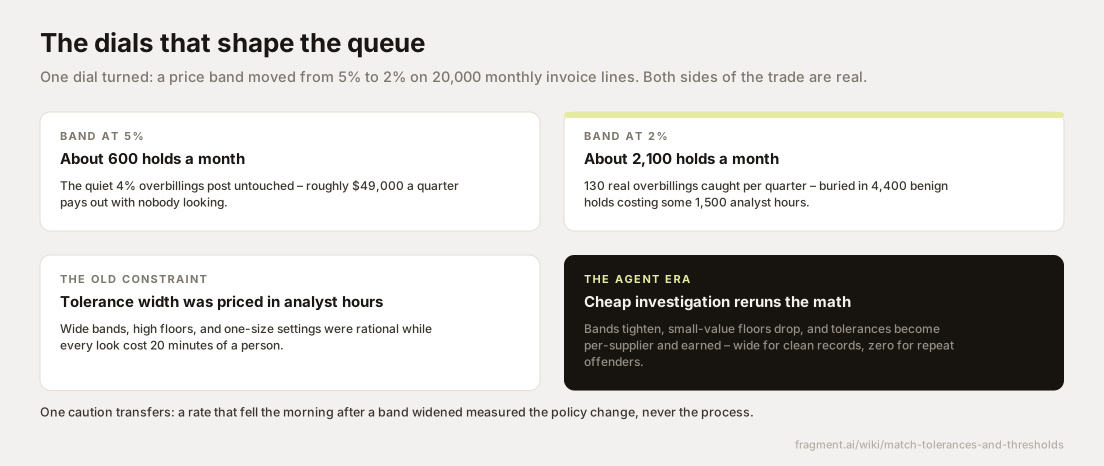
Each match tolerance is a dial, and every dial trades something
Match tolerances in a typical ERP are a small family of settings, each balancing a specific risk against a specific pile of work.
- Percentage price bands. The invoice unit price may differ from the PO price by some percentage, commonly 2% to 5%. Wider bands wave through currency drift and rounding; they also wave through genuine overbilling that sits inside the band. Narrower bands catch the overbilling and flag the noise along with it. Every breach lands in the hold queue as one of the price variance exceptions.
- Absolute caps. A percentage alone scales badly. Two percent of a $190,000 equipment line is $3,800 waved through without a look, while 2% of a $40 fastener line flags a variance of 80 cents. Most companies pair the percentage with a fixed cap, so a line holds only when it breaches both.
- Quantity bands. These are usually absolute rather than percentage, and usually much tighter than price, often zero over-receipt. A price gap is a commercial disagreement; a billed quantity above the receipt means paying for goods with no evidence of arrival. Quantity and receipt mismatches covers what happens when this band trips.
- Small-value floors. Anything under a dollar figure, $250 or $500 or $1,000, skips matching entirely or gets a lighter two-way check against the PO alone. The floor exists because investigating a $60 discrepancy costs more than any plausible recovery. It is also a standing blind spot, and suppliers who split their billing into sub-floor invoices have found it.
- Per-category and per-supplier bands. Commodity metals reprice with an index between order and invoice, catalog parts should land on the penny, and freight-heavy categories carry surcharges that behave differently from unit prices. Category-level and supplier-level bands acknowledge this. Many ERPs support them; far fewer companies use them, because every additional band is another setting somebody has to defend.
Most companies set match tolerances once and never come back
The honest history of most tolerance frameworks is short. A systems integrator arrived at ERP implementation with defaults copied from a template or from the previous client's project. A workshop reviewed them for an hour somewhere between chart-of-accounts decisions and payment-run scheduling, someone from finance signed the configuration document, and the settings went to production. Then they froze. Changing a tolerance in a live ERP means a change request, testing, and a transport through change control, and ownership is ambiguous: AP feels the workload, procurement owns the supplier relationships, internal audit owns the risk, and IT owns the transaction where the number lives. A setting with four part-owners gets revisited by none of them. Meanwhile the supplier base, the category mix, and the price environment the defaults were tuned for all moved on.
Take one dial and turn it: a price band from 5% to 2%
In practice, the trade shows up in the first month. Take a manufacturer processing 20,000 PO invoice lines a month through SAP with a 5% price band and a $200 cap, seeing roughly 600 price holds a month. Tighten the band to 2% and the same invoice flow produces about 2,100 holds, an extra 1,500 every month.
Both sides of the ledger are real. Inside the newly flagged population sit genuine findings: over a quarter, review of the extra holds turns up around 130 confirmed overbillings averaging $380 each, call it $49,000 a quarter that the 5% band had been posting without a look, some of it the same supplier making the same "error" every month. Around those findings sit roughly 4,400 benign holds per quarter: rounding, freight allocated into unit price, currency movement on the day of invoicing, an index reprice the contract fully authorizes. At 20 minutes of investigation per hold, the benign population costs about 1,500 analyst hours a quarter, close to three full-time people, to protect $49,000 in recoveries. The arithmetic argues for loosening; the finding of repeated overbilling argues for tightening. Where the dial ends up depends on what a single investigation costs, and that assumption is the one now changing.
Cheap investigation changes where every dial belongs
Every number in that example has an analyst's hourly cost baked into it. Tolerance width was always an economic answer to one question: what does it cost to look? When looking costs 20 minutes of a person, wide bands, high floors, and one-size-fits-all settings are rational, and the queue is deliberately kept blind to small discrepancies because seeing them would be unaffordable.
When an AI agent works the queue, an investigation costs minutes of compute. The agent pulls the PO history, reads the contract's pricing schedule, checks the receipt trail and the supplier's resolution history, and either clears the hold with a documented rationale or escalates it with the evidence attached. At that cost per look, the same economics run backward. The 2% band that buried three analysts becomes affordable, since the 4,400 benign holds clear themselves and the 130 overbillings still surface. The $500 floor can drop toward zero, because a $60 discrepancy now merits its sixty seconds of scrutiny. And tolerances can become what policy always wanted them to be: per-supplier and earned. A supplier with two years of clean index-clause repricing, every variance traced back to the contract formula, can carry a 6% band without added risk. A supplier with three confirmed overbillings in eighteen months carries a zero band, every line checked, until its record recovers. That is a control posture no static configuration table expresses and no team staffed for manual review could enforce.
One caution transfers from the manual era into this one. Tolerance settings sit inside every exception metric a company reports, so an exception rate that fell the morning after a band was widened measured the policy change rather than the process. Anyone comparing their rate against peers should read the invoice exception rate benchmarks page, which treats that measurement problem in full.
Fragment builds AI agents that do the investigating this rethink depends on, working each flagged line inside a company's existing SAP or Ariba environment against the contract, the price history, and the receipt trail, with no rip and replace. Tighter bands, lower floors, and per-supplier settings only hold up as policy if every extra flag gets resolved, and that resolution is the work the agents carry. See how the workflows run or request a demo.