

PO amendments: how orders drift from reality, and how agents catch it

PO amendments are the formal changes that bring a purchase order back in line with what the buyer and supplier currently agree on – a revised quantity, a pushed delivery date, an updated price, a substituted part. A purchase order is a snapshot of an agreement at the moment it was transmitted, and everything it describes keeps moving after that moment, so the document starts decaying the day it goes out. The amendment is how the record catches up, and the practical question on any open order is how far reality has traveled since the record last did.
Like the rest of this wiki, this page is written for companies where AI agents carry the operational load – reading confirmations, reconciling documents, clearing match failures – and people keep the decisions that need judgment. A conventional glossary treats an amendment as a transaction code with a change order form in front of it. This page treats it as the visible tip of something larger: most of the drift between an order and reality never becomes an amendment at all, and that gap is where downstream exceptions are born.
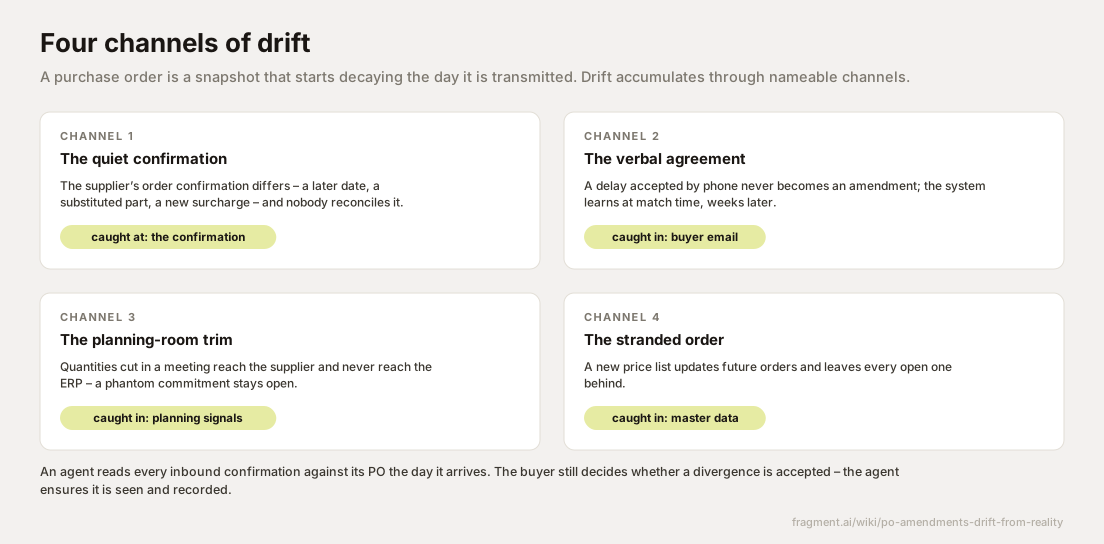
Drift enters through four channels, and each one skips the amendment
PO amendments lag reality because divergence arrives through channels nobody owns, and each channel has its own fingerprint.
The first channel is the supplier's order confirmation – the document acknowledging the PO and stating what the supplier will actually do. Confirmations differ from the orders they answer far more often than anyone assumes, because the confirmation is where the supplier corrects the buyer's optimism. In practice, that looks like a PO for 400 machined housings at $118.50 each, delivery June 9, answered by a confirmation promising June 30, quoting part 7742-C revision D instead of revision C, and adding a 4% energy surcharge the buyer never discussed. If nobody reconciles that confirmation against the order line by line – and in most procurement teams nobody does, because confirmations arrive as PDF attachments in a shared inbox – the ERP keeps executing against June 9, revision C, and $118.50. Three divergences just entered the process, and the first anyone will hear of them is a receiving mismatch in July and a price variance exception in August.
The second channel is agreements that live in conversation. A supplier calls to ask for two more weeks; the buyer, looking at inventory cover, says fine. That decision is legitimate and probably correct, and it exists nowhere except two people's memory and perhaps a one-line email. Planning keeps scheduling against the original date, the expediting report flags the order as late, and when the goods arrive on the verbally agreed date, the delay reads as a supplier failure on the scorecard. The agreement was real; the record never heard about it.
The third channel runs the opposite direction: changes that reach the supplier and miss the ERP. Take a monthly planning review that trims an order for 10,000 brackets at $11.00 down to 6,500 because a customer program slipped. The planner emails the supplier that afternoon, the supplier adjusts the build, and the partial cancellation that should trim the PO never gets keyed. The supplier ships 6,500, the goods receipt – the record of what physically arrived – posts against a PO that still says 10,000, and the order sits open for months with $38,500 of phantom commitment inflating the open-order report and every forecast that consumes it.
The fourth channel is master data, the shared reference records for prices, parts, and suppliers. When a renegotiated price list loads on July 1, it governs every PO cut after July 1. The thirty open orders cut in June still carry the old prices, and the supplier, invoicing from the new list, bills all thirty at the new numbers. Each invoice fails its match, and each failure resolves the same way: the PO was stale. Master-data updates fix the future and strand the present, and the stranded orders surface one at a time as exceptions rather than all at once as an amendment batch.
You can measure how far behind your PO amendments run
Drift feels anecdotal until you count it, and three measurements make it visible without any new software.
- The confirmation-versus-PO delta rate. Pull one month of order confirmations and compare each against its PO on date, quantity, price, part number, and terms. The share that differ on at least one line is the rate at which drift is entering your process right now, before any downstream symptom appears.
- The stale-PO share of exception resolutions. Read the last quarter's resolved invoice exceptions and count how many closed with some version of "the PO was out of date." That share is drift measured at the exit, months after it entered, and it explains a large slice of why invoice exceptions happen in the first place.
- Receipt-versus-PO variance by buyer. Rank buyers by how often their receipts disagree with their open PO lines. The point is coaching material and channel diagnosis: a buyer whose orders drift on dates has a different problem from one whose orders drift on price.
Wherever you measure, expect the drift to concentrate on two order types. Long-lead orders drift more because there is simply more calendar time for demand, prices, and specifications to move between transmission and receipt. Blanket orders – umbrella POs that authorize a period of supply drawn down through individual releases – drift more because every release is another transaction that can diverge, and the umbrella terms age for a year while the market moves underneath them. An order that lives longer or transacts more often accumulates more divergence; the exposure compounds with time and volume.
An agent reconciles every confirmation on the day it arrives
Drift compounds because of timing: the divergence is discovered months after it occurs, by someone who lacks the context to resolve it. An AI agent working across source-to-pay attacks the timing directly. It reads every inbound order confirmation against its purchase order line by line on the day the confirmation arrives, flags June 30 against June 9, the revision change, and the undiscussed surcharge, then drafts the amendment with the evidence attached – the confirmation excerpt, the PO line, the delta – and routes it to the buyer while the buyer still remembers the conversation that produced it. Answered that day, the divergence becomes a clean amendment and the downstream match failure never happens, because the record was corrected months before the invoice showed up. That is the turnaround discipline change order SLAs try to impose by policy, applied by default to every confirmation. The conversational channel narrows too: the two-week delay accepted by phone still needs the buyer to say so, but the one-line email trail is usually enough for an agent monitoring the order to notice the discrepancy and ask.
What the agent cannot do is decide. Whether a 4% surcharge is acceptable, whether June 30 is livable for the production schedule, whether revision D passes engineering review – those are the buyer's calls, made against contract terms and build plans the agent can surface but should not weigh alone. The agent's job is narrower: guarantee that every divergence is seen, recorded, and answered while it is still cheap to answer. Drift survives on silence, and continuous reconciliation removes the silence.
Fragment builds AI agents that run this reconciliation inside a company's existing SAP or Ariba environment – reading each inbound confirmation against its PO, drafting amendments with the evidence attached, and keeping open orders aligned with what buyers and suppliers have actually agreed, with no rip and replace. See the workflows Fragment's agents run or book a demo.