

Two-way vs three-way vs four-way matching, when agents work the failures

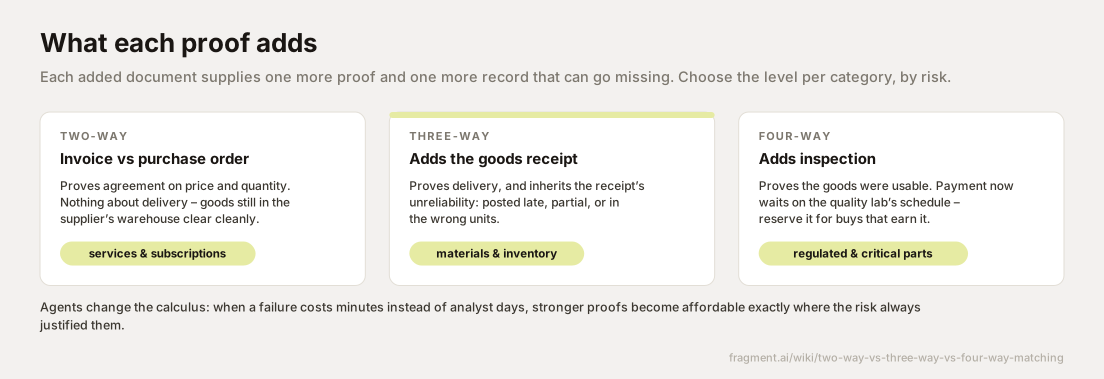
The number in each name counts the documents an accounts payable system compares before it pays an invoice. Two-way matching checks the invoice against the purchase order and proves both parties agree on price and quantity. Three-way matching adds the goods receipt, the warehouse record of what physically arrived, and proves delivery. Four-way matching adds an inspection or quality-acceptance record and proves the goods were usable. In any two-way vs three-way vs four-way matching decision, each added document supplies one more proof and one more record that can go missing, post late, or disagree with the others.
This entry sits in a wiki written for a procure-to-pay process where AI agents carry the operational load – comparing documents, chasing receipts, resolving mismatches – while people keep the judgment calls. A standard glossary presents the three levels as escalating controls a clerk enforces. This page treats them as a decision about how much proof to demand, made in a world where an agent absorbs most of the cost of demanding it.
Each document is a witness, and each witness can fail to appear
A purchase order, the buyer's formal record of what was ordered and at what price, proves agreement on terms. It proves nothing about performance: a supplier can invoice accurately against a genuine PO for a shipment still sitting in their own warehouse, and a two-way match will wave the invoice through. The goods receipt closes that gap, which is why three-way matching became the default control for physical goods. Delivery gets proven by the receiving clerk's posting at the dock.
The receipt is also the least reliable witness in the set. It depends on a busy dock counting cartons correctly and posting the same day, and in practice receipts post late, post partially, or post against the wrong PO line. A large share of invoice exceptions trace back to the receipt rather than to anything the supplier did; the quantity and receipt mismatches page catalogs the failure modes. Three-way matching buys proof of delivery and inherits the receipt's flakiness as a permanent operating cost.
The fourth document, an inspection or acceptance record, proves the goods were usable rather than merely present. That is a claim no receipt can make – a pallet of castings can arrive complete, on time, and out of spec. The price of the proof is that a fourth team, usually quality, must create a record before finance can pay, and quality departments do their work on quality's schedule.
Two-way vs three-way vs four-way matching is a decision made per spend category
Companies get this wrong by picking one level for the whole enterprise. The level should follow the risk profile of the category, because each category has a different answer to the question "what could this invoice be lying about?"
Take a $15,000 monthly legal retainer or an $1,800 SaaS subscription. There is no shipment, so a goods receipt would be a formality an admin types to release payment – a keystroke dressed up as evidence. Two-way matching against the PO or contract line is the honest control, and forcing service spend through a three-way policy just teaches people to fabricate receipts on schedule. (Service spend that never had a PO at all sits outside this ladder entirely; non-PO invoices need their own path.)
Now take direct materials. A plant orders 40,000 M8 zinc-plated bolts at $0.62 each, a $24,800 PO. The supplier ships 38,500 in the first truck and invoices for the full 40,000. Under two-way matching that invoice clears, because it agrees with the PO perfectly; the company pays $930 for bolts it does not have. Under three-way matching the receipt shows 38,500, the match fails on quantity, and the invoice holds until the balance arrives or a credit is issued. For raw materials, components, and inventory, the receipt is cheap evidence against exactly the loss that matters, and three-way is the right default.
Four-way belongs to the categories where a defective delivery costs far more than the invoice. A medical device manufacturer buying 500 kg of titanium alloy bar at $58 per kg has a $29,000 invoice and a seven-figure recall if nonconforming material reaches an implant line. There, payment should wait for the quality record: the receipt posts the material into inspection stock, the lab verifies the certificate of analysis against the alloy specification, and only the formal acceptance releases both the stock and the invoice. Aerospace fasteners, active pharmaceutical ingredients, and food-contact packaging sit in the same tier.
Four-way matching pays for itself only where a bad part costs more than the invoice
The mechanics make the cost concrete. In an SAP environment, a goods receipt for an inspection-relevant material creates an inspection lot, and the material waits in quality-inspection stock until someone records a usage decision – the QM verdict that accepts or rejects the lot. Wire the invoice hold to that decision and the control is airtight: no payment for material that failed inspection, ever. The same wiring means a nine-day backlog in the lab becomes a nine-day payment delay on an invoice with nothing wrong with it, and the supplier's collections team will call about it.
So four-way matching is a narrow tool. Where regulators, safety, or physics demand proof of conformance, the stalled invoices are worth it. Applied to spend where a defect is an inconvenience, it adds a fourth document that can go missing and a fourth department that can become AP's bottleneck. Reserve it, category by category, for the buys where the usage decision genuinely changes whether the company should pay.
Cheap resolution shifts the calculus toward stronger proofs
The traditional pressure in two-way vs three-way vs four-way matching debates came from clerical workload. Every added document multiplies match failures, and when every failure lands on a fixed-size AP team, the queue math starts driving the control design. That is how companies end up running two-way on goods categories that deserve a receipt check, and widening match tolerances past what the risk analysis supports: the control was weakened to protect the team, and the weakening was rational at the time.
AI agents change the cost side of that equation. When an agent works a failed match – pulling the PO change history, finding the receipt posted against the wrong line, chasing the dock for the missing posting, recomputing a price against the contract – the marginal cost of enforcing a stricter level falls toward the cost of the documents themselves. The manual vs automated exception resolution comparison is what moves: the exceptions still occur, and they stop consuming analyst days. A category that always warranted three-way matching on risk grounds can now afford it on workload grounds too.
The honest limit sits at level four. An agent can create the invoice hold, watch for the usage decision, chase the lab when a lot ages, and release payment the moment acceptance posts. The inspection itself is physical work at a bench or a dock, and no software performs it. Agents remove the paperwork drag around the quality record; the quality capacity still has to exist, which is one more reason four-way matching should stay reserved for the categories that earn it.
Fragment builds AI agents that resolve the exceptions every match level produces – the price and quantity failures of two-way and three-way, the aging inspection lots of four-way – working inside a company's existing SAP or Ariba stack with no rip and replace, so stronger proofs stop costing analyst time. See what the workflows cover or request a demo.