

The cost of invoice exceptions: a ledger agents change line by line

The cost of invoice exceptions is the sum of five recurring charges: the labor to resolve each case, the time it pulls from buyers and requesters, the early-payment discounts that expire while it sits, the late penalties and duplicate payments that slip through under backlog, and the drag it puts on supplier relationships. An invoice exception is a supplier invoice that fails a validation check, most often the three-way match, the line-by-line comparison of invoice, purchase order, and goods receipt, and drops into a hold queue for investigation. Each of those five charges recurs every month, and most of them never appear in the accounts payable budget.
This wiki writes source-to-pay definitions for companies where AI agents carry the operational load, matching documents, reading contracts, and resolving holds, while people decide the cases that need judgment. A glossary written for clerks prices an exception as a processing task. This page prices it as a ledger, then asks which lines an agent working the queue can change and which line it honestly cannot.
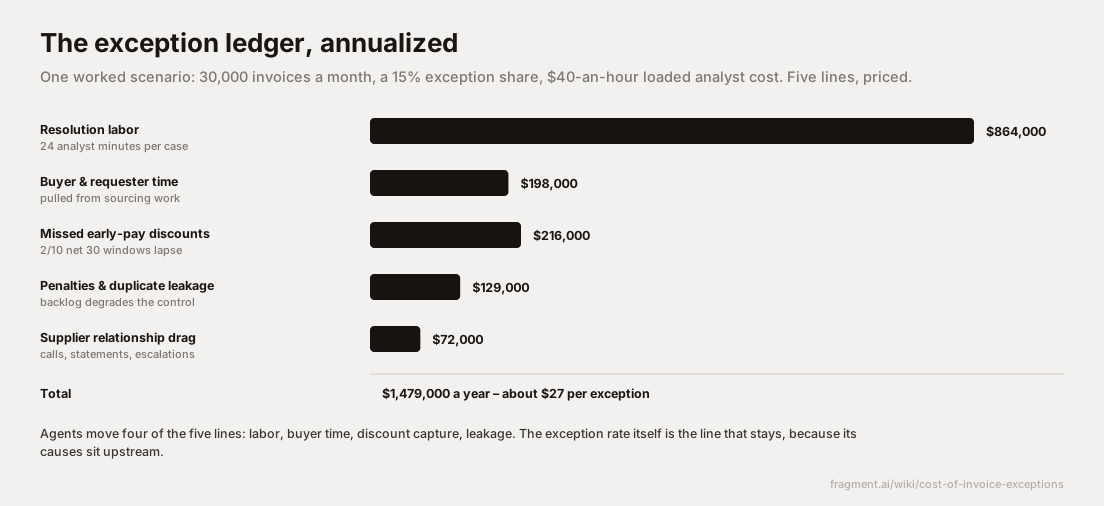
The cost of invoice exceptions only becomes real in a worked ledger
Percentages hide the money, so the cost of invoice exceptions is best priced through one concrete operation. Take a mid-size AP team processing 30,000 invoices a month at an average value of $2,000, or $60 million of monthly invoice volume, on SAP with a shared-services team working the queue. Give it an exception share of 15 percent, which is 4,500 held invoices a month; how a share like that compares with peers is covered in invoice exception rate benchmarks. Price analyst time at a loaded rate of $40 an hour, meaning salary plus benefits, systems, and overhead rather than base pay alone. Every number that follows is this scenario's own arithmetic, a worked illustration rather than research data, and the point is the structure of the ledger rather than the exact figures. Swap in your own volumes and the lines recalculate.
Two labor lines open the ledger, and only one sits in AP's budget
The first line is direct resolution labor. In the scenario, a typical exception takes two touches averaging 12 minutes each, one to investigate and one to close after a reply arrives, for 24 minutes of analyst time per case. Across 4,500 monthly exceptions that is 108,000 minutes, or 1,800 hours, which at $40 an hour comes to $72,000 a month and $864,000 a year. A touchless invoice, one that posts and pays with no human touch, costs almost nothing by comparison, which is why the value of a higher touchless rate compounds so quickly.
The second line is the time exceptions pull from people outside AP. Say 40 percent of cases need a buyer or requester to confirm a price, a receipt, or an approval. That is 1,800 cases a month at roughly 10 minutes each, or 300 hours of buyer and requester time, priced at a $55 loaded rate for $16,500 a month and $198,000 a year. This line lands on procurement and the business, so AP's own reporting never shows it, and it is paid in the most expensive currency available: attention pulled from sourcing and operating work.
The remaining lines of the cost of invoice exceptions come from delay
The third line is missed early-payment discounts. A 2/10 net 30 term means the buyer may deduct 2 percent by paying within 10 days, with the full amount due at 30. Skipping the discount buys 20 extra days of float for 2 percent of the invoice: on a $10,000 invoice, that is $200 to hold $9,800 for 20 days, which annualizes to a shade over 37 percent. Few treasuries can earn 37 percent on cash, so a missed discount is a real loss. In the scenario, suppose 10 percent of spend carries such terms, or $6 million a month. Exceptions hit that spend at the same 15 percent share, holding $900,000 past the 10-day window, and the forfeited 2 percent is $18,000 a month, or $216,000 a year.
The fourth line covers late-payment penalties and duplicate leakage. Suppose 5 percent of exceptions, 225 invoices a month, age past their due date and incur interest or penalties averaging 1.5 percent of invoice value, which on $2,000 invoices is $6,750 a month. Backlog pressure also degrades the control itself: a reviewer flushing a queue at month-end approves what a calm reviewer would question. Give the scenario one duplicate invoice payment a month at $8,000, with half eventually recovered through audit, for a $4,000 net monthly loss. Together the line runs $10,750 a month, about $129,000 a year.
The fifth line is supplier relationship drag. Held invoices generate inquiry calls, statement reconciliations, and escalations. Give the scenario 600 supplier contacts a month at 15 minutes each, which is 150 hours, or $6,000 a month and $72,000 a year at the analyst rate. The unpriced remainder is worse: suppliers who are paid late put accounts on prepayment terms, hold shipments, and concede less at renewal. Exception aging is the multiplier here, since a hold that clears in two days generates none of this and a hold that sits for three weeks generates all of it.
The ledger totals $1.48 million a year, and it understates
Summed, the scenario's annual ledger reads:
- Resolution labor: $864,000
- Buyer and requester time: $198,000
- Missed early-payment discounts: $216,000
- Penalties and duplicate leakage: $129,000
- Supplier relationship drag: $72,000
That is $1,479,000 a year, about $27 for every one of the 54,000 annual exceptions, against a queue most budgets record only as the salaries of the AP team. The total still understates the true cost, because several charges resist pricing: working capital locked in disputes that can be neither paid nor closed, audit findings traced to rushed overrides, and the negotiating position procurement gives up when its company is known as a slow payer.
An agent rewrites four lines and leaves one alone
Read the ledger from an agent's side and the lines sort themselves. Resolution labor moves first: an agent that can pull PO history, contract terms, receiving records, and past resolutions investigates a routine case in minutes and closes it with the evidence attached, so the 24 minutes of analyst time per case collapses for every exception whose proof exists in the records, and the team's hours shift to the judgment calls. Buyer time moves with it, since an agent that finds the answer in a contract clause never sends the buyer an email at all. Discount capture returns because cases clear inside the 10-day window instead of three weeks after it, and the penalty and duplicate line shrinks because an agent checks duplicate history with the same care at month-end as on a quiet Tuesday. Aging stops compounding, which quiets the supplier phone line.
The line an agent leaves alone is the exception count itself. Exceptions are created upstream, by stale price masters, by suppliers who invoice before goods ship, by POs cut after the work started, and resolving the resulting holds faster does nothing to those causes. The why exceptions never go to zero page works through them; the honest summary is that agents cut the cost per exception across four lines while the fifth variable, the rate, stays an upstream project. In the scenario, the ledger shrinks even though the queue's intake does not.
Fragment builds AI agents that work this ledger directly, resolving routine invoice exceptions autonomously inside your existing SAP or Ariba environment, with the evidence trail attached and the judgment calls routed to your team. See how the workflows run or request a demo.