

Why exceptions never go to zero, even with agents on the queue

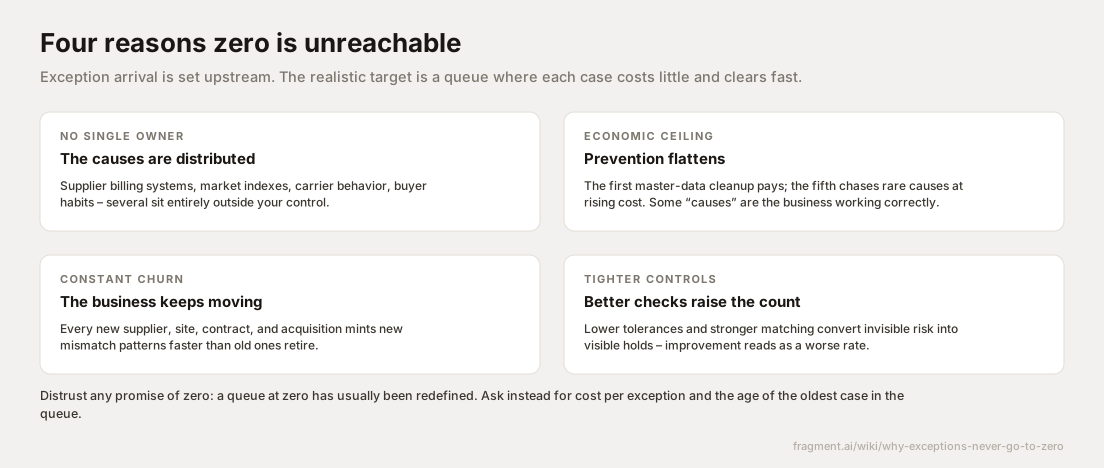
Exceptions never go to zero because their causes are spread across parties no single team controls, prevention has an economic ceiling that sits well above zero, the business mints new mismatch patterns faster than old ones retire, and tighter controls convert invisible risk into visible holds. The realistic target is a queue where each exception costs little and clears quickly.
Why exceptions never go to zero is a question this wiki has to answer honestly, because it defines source-to-pay for a world where AI agents do the operational work – matching documents, reading contracts, clearing holds – and people keep the judgment calls. In that world it would be easy to promise an empty queue. This page redefines the target instead: four structural reasons zero is unreachable, and the two numbers that replace it.
The causes have no single owner
The first reason why exceptions never go to zero is ownership: the events that produce a failed match originate with different parties, and several of them sit entirely outside the buyer's control. An invoice exception is an invoice that fails a validation check before payment, most often the three-way match – the line-by-line comparison of invoice, purchase order, and goods receipt, the record confirming what actually arrived. For that comparison to succeed, a supplier's billing system, a market price, a carrier's delivery pattern, a warehouse clerk's posting, and a buyer's data entry all have to agree.
Take a supplier that generates its invoice the moment a truck leaves its dock. Every order with three days of transit reaches AP ahead of its goods receipt and fails the match against a received quantity of zero. The buyer can raise it at the quarterly business review, and the supplier will point out that its billing system has worked this way for fifteen years across four hundred customers. That supplier will keep billing on dispatch. The same logic holds for a commodity price that resets against an index mid-contract, a carrier that splits one order across three trucks, and a buyer who agrees to a substitution by phone and leaves the purchase order untouched. The full catalog is on why invoice exceptions happen; the point here is that AP owns none of these causes, and several have no owner on the buyer's org chart.
Prevention pays early, then stops paying
Prevention follows a curve that flattens hard. The first master-data cleanup – deduplicating vendor records, correcting stale price lists, requiring purchase orders on the top spend categories – removes the largest causes at low cost. The fifth initiative chases causes that appear a dozen times a year, and each one removed costs more than the last. Somewhere on that curve, a prevented exception starts costing more than a resolved one.
Some of what remains is the business working correctly. Take a plant where a conveyor gearbox fails at 11pm. Maintenance buys the $4,300 replacement from the nearest distributor, the line restarts by 3am, and purchasing cuts the purchase order retroactively the next morning. The invoice arrives referencing a PO dated after it and goes on hold. That retroactive-PO exception is the receipt for a saved production shift. Preventing it means making the plant wait for procurement paperwork while the line stands still, trading minutes of resolution work against hours of lost output.
The business changes faster than the process hardens
The third reason is churn. Every new supplier arrives with its own billing habits, every new site with its own receiving practices, every new category with document types the match has never seen, and every renegotiated contract with pricing the open purchase orders do not yet reflect. An acquisition compresses all of it into a single quarter. In practice, that looks like 800 inherited vendor records, a second ERP, and a units-of-measure clash where the acquired system sells cartons of 12 while the parent buys eaches, so an invoice for 40 cartons meets a purchase order for 480 units and holds on quantity until someone maps the conversion.
Prevention under these conditions is a treadmill: a program a company runs permanently, at a speed set by its own growth. The only prevention project with an end date belongs to a company that has stopped adding suppliers, sites, and contracts. Everywhere else, a flat exception rate during growth is already evidence of improvement.
Tighter controls raise the measured exception rate
The fourth reason why exceptions never go to zero is the least intuitive: improving the control environment surfaces more exceptions. Every check a company adds converts invisible risk into visible holds. In practice, that means a company that lowers its price tolerance – the variance band within which an invoice may differ from its purchase order and still post – from 5% to 2% on direct materials will watch invoices that used to auto-post start holding, including the quiet 4% overbillings that used to clear untouched. The same happens when a services category moves from two-way matching, invoice against order, to three-way matching with a service entry confirming delivery. Measured by exception rate, the process got worse; measured by payment risk, it got better. Match tolerances and thresholds covers how those settings get chosen, and it is one reason raw exception rate benchmarks mislead across companies: a low rate can describe clean processes or loose checks, and the number alone cannot say which.
Once zero is off the table, cost and age are the numbers that matter
Accepting the four reasons above changes the management question from how many exceptions occur to what each one costs and how long it lives. The cost of invoice exceptions is dominated by investigation labor and by the damage of slow resolution: missed early-payment discounts and suppliers placing accounts on credit hold. Exception aging measures the second half, how long holds survive, and it compounds, because a hold nobody touches for three weeks matures into a supplier escalation.
These are the two numbers agents actually move. An agent that reads the purchase order, the contract, the receiving history, and past resolutions can clear the cases whose proof exists in the records within minutes and hand people only the genuine judgment calls, the difference worked through in manual vs automated exception resolution. The rate stays where the upstream causes put it; the cost per case and the age distribution collapse.
Resolution at that speed also produces a byproduct prevention teams have never had: a ranked defect list. Every case an agent closes records its cause – which supplier billed on dispatch, which price record was stale, which plant posts receipts late – so a month of resolutions reads as a prioritized work order for its upstream owners. The master data team gets its ten worst records, and the category manager gets the supplier behind sixty dispatch-billing holds. Agents leave the rate to its upstream owners and hand those owners the evidence to move it.
Distrust any promise of zero
A queue that reaches zero has usually been redefined: tolerances opened wide, checks removed, hold categories renamed. Each of those moves buys a cleaner metric with real payment risk. The questions worth asking, of a vendor or your own operation, are the two that stay meaningful: what does one exception cost to resolve, and how old is the oldest case in the queue this morning? A well-run process answers in dollars and hours. A poorly run one answers with its exception rate.
Fragment builds AI agents on exactly this premise: exceptions are permanent, so resolution capacity is the lever. The agents work the queue inside a company's existing SAP or Ariba environment, clear the cases the records can prove, escalate judgment calls with the investigation attached, and log every cause so upstream owners get their defect list. See how the workflows run or request a demo.