If you sell into the data center supply chain right now, the business probably looks great on paper. Backlog stretching two and three years out. Customers locking in forward contracts just to hold their place in line.
Then you walk into the procurement team's area.
That's the least scalable part. And it's the part of the story most companies in this ecosystem haven't caught yet.
The five largest U.S. cloud and AI infrastructure providers committed somewhere between $660 and $690 billion to capex in 2026, nearly doubling 2025. Dell'Oro projects total data center capex will hit $1.7 trillion by 2030. BloombergNEF tracked over 23 gigawatts of data center capacity under construction globally at the end of last September, three quarters of it in the U.S.
That money flows downstream. Power equipment, cooling, switchgear, fiber, generators, racks, structural steel, controls, all the way back to copper, electrical steel, and rare earth processing. Demand for generator step-up transformers is up 274% since 2019, according to Wood Mackenzie. Lead times for standard power transformers ran 30 to 60 weeks pre-pandemic. They now average 128 weeks, with some orders running four years. Sightline Climate analysis suggests roughly 30 to 50% of the data center capacity planned for 2026 will slip, driven partly by transformer and switchgear shortages.
For companies on the supply side of all this, it's the biggest revenue opportunity they've ever seen. It's also quietly breaking their procurement function.
Growth that outruns the back office
What growth at this rate does to operations is pretty mechanical. New suppliers, new SKUs, new project codes, new one-off rules. The volume of exceptions grows faster than the volume of transactions. Past a certain point, the ERP that was picked when the company was a quarter its current size stops being able to hold the operation together.
Ardent Partners' 2025 AP metrics report puts the average invoice exception rate at 22%. Top-quartile teams sit at 9%. What nobody likes to say out loud is that when revenue is growing 30 to 60% a year, exception volume isn't growing at the same rate as revenue. It's growing faster. New suppliers arrive with new invoice formats. Engineers spin up new project codes on the fly to keep up with hyperscaler timelines. Contracts get amended monthly. The kind of knowledge that keeps the operation running, this vendor always invoices a week ahead of shipment, that subcontractor uses a different unit of measure on copper than on aluminum, the Phoenix plant codes labor differently than Dallas, accretes faster than anyone has time to write down.
A lot of it is in the head of one analyst who's been at the company longer than the CFO. When she leaves, or gets burnt out and quits, the exception rate ticks up another two points and nobody's quite sure why.
Scaling with human labor won't work
The traditional fix is to scale the team. Grow the shared services team. Open an offshore center. Send overflow to a BPO. Sign a six-figure consulting contract for a transformation. That playbook has worked for thirty years and it does the job at a steady state.
However, it does not work in a hyper-growth scenario. You can't hire sourcing analysts at 60% year over year. Even if you could, every dollar going to back-office headcount is a dollar not going to capacity expansion. Capacity is the actual constraint on the next leg of growth.
Software seems like the obvious answer. The problem is that the platform itself gets outgrown before it pays back. Procurement Insights research, drawing on Gartner and McKinsey benchmarks, finds that mid-sized and enterprise companies pull the plug on failed procure-to-pay initiatives in an average of 18 to 24 months. By the time the rollout finishes, the business on the receiving end isn't the business that signed the contract. The supplier list has doubled. Three of the entities in the system have reorganized. The process maps don't match anymore. And even if you could get it live, most procurement software is built for humans to do the work, which means scaling still gates on hiring.
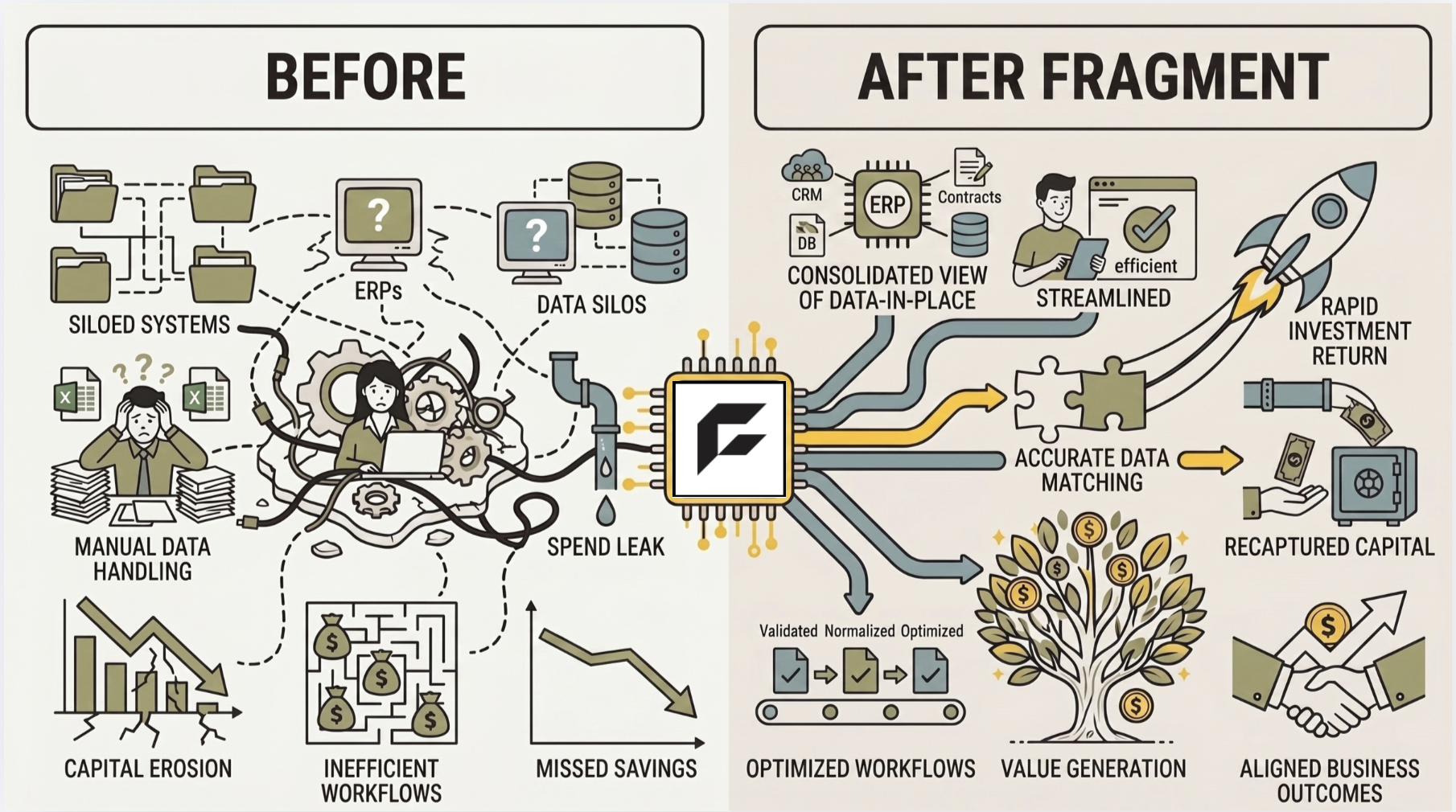
The other problem is fragmented context. These platforms were built to operate inside a single system. Procurement at a fast-growing supplier doesn't live inside a single system. It lives across the ERP, the engineering BoM, the contract repository, supplier portals, email threads where someone agreed to a price change, and the spreadsheet a senior buyer maintains because nothing else captures the shortcuts cleanly. McKinsey found that procurement functions use less than 20% of available data. The data is there. The tools just can't reach across enough of it to reason about anything.
Agentic AI that autonomously resolves issues is the answer
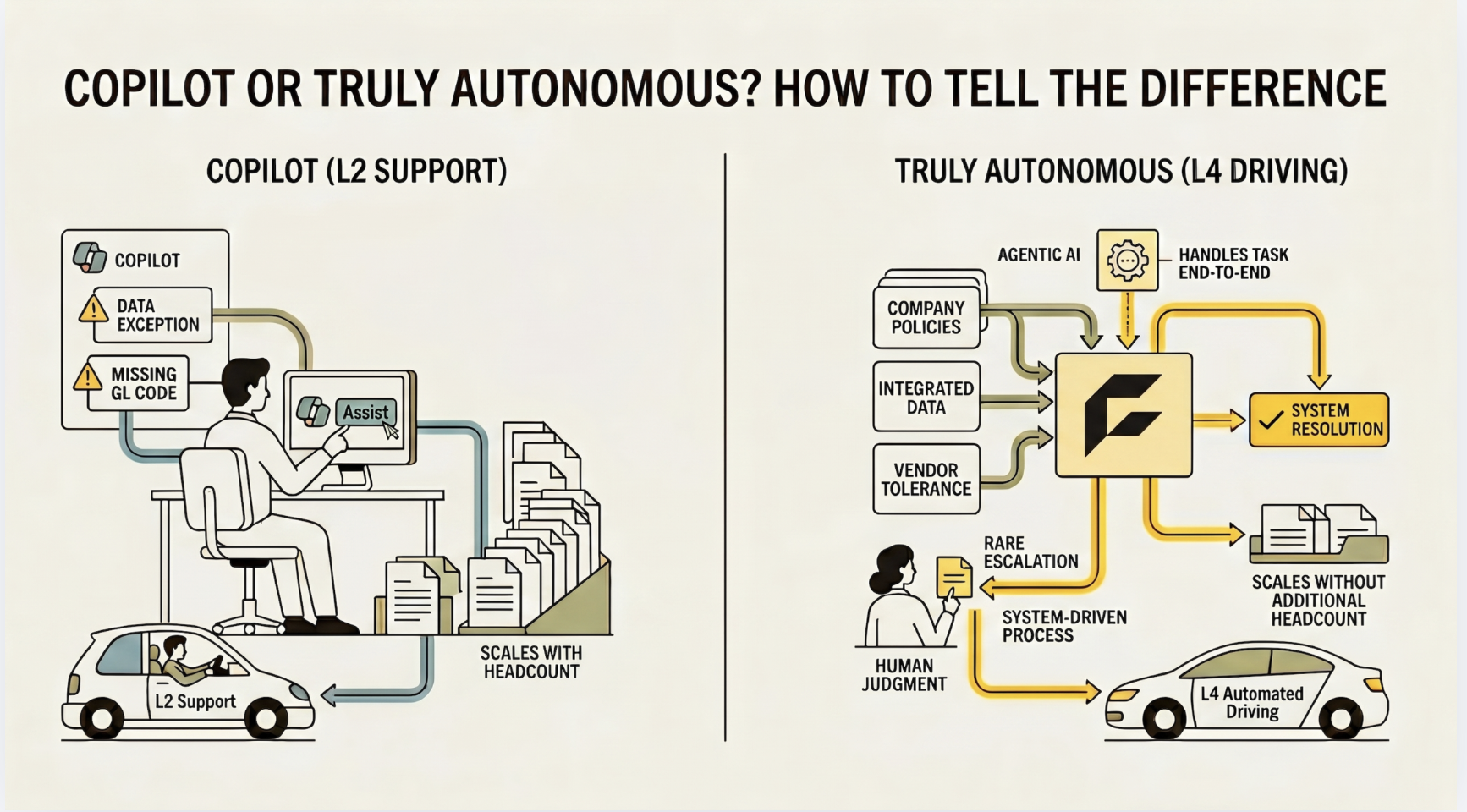
Picture a system that already knows your operation the way your most senior buyers do. It understands that "Houston Yard 4" and "HOU-Y4-001" are the same site. It knows this supplier always ships heavy on copper and short on aluminum. It knows the Dallas plant approves three-way matches with a 2% variance on commodity items while Phoenix approves at 0.5%. It reads context from emails, contract amendments, and prior approval patterns. When an invoice comes through with a missing PO line or a quantity mismatch, the system looks at everything it already knows about that vendor, that project, that pattern, and clears it. No queue. No analyst pinged at 6pm on a Friday.
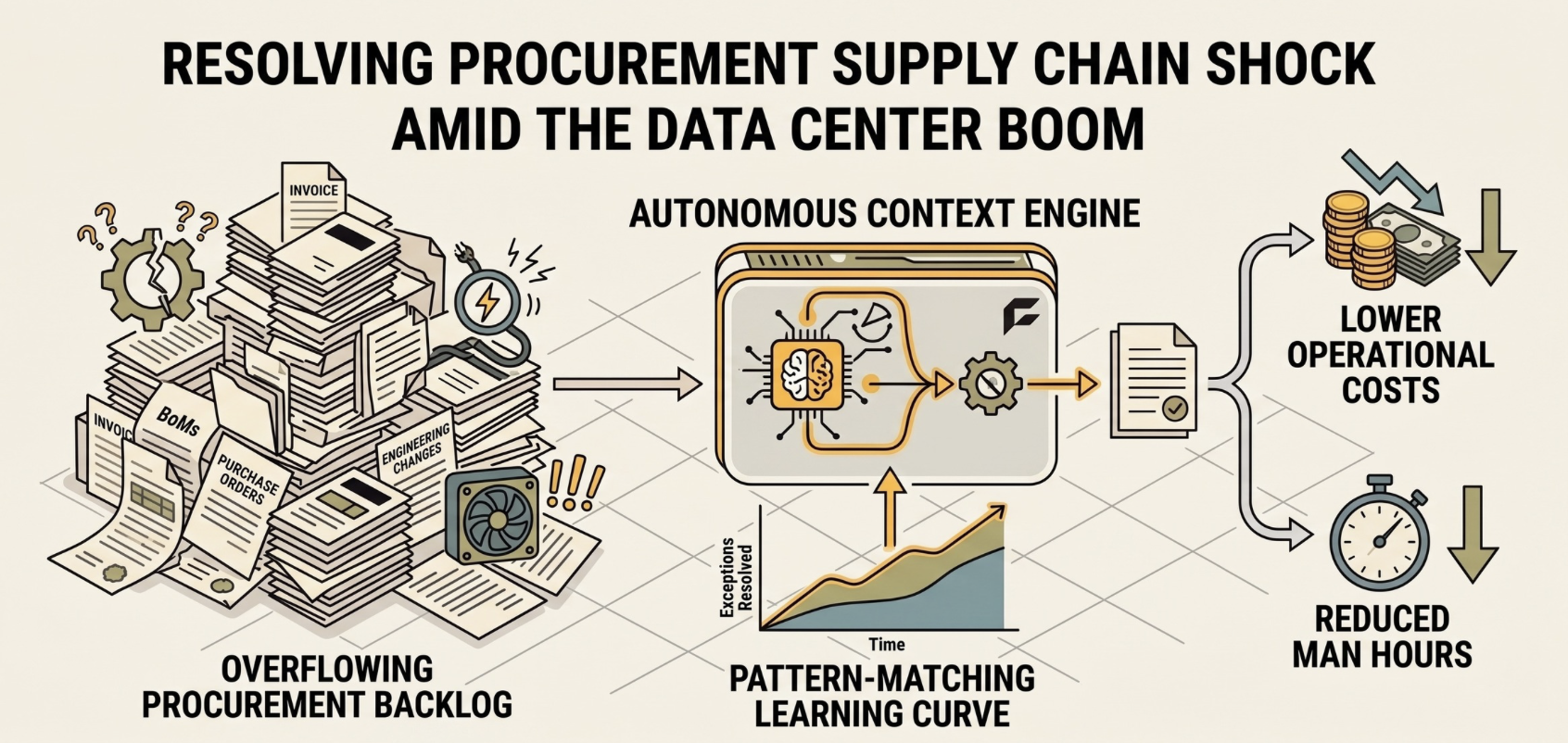
The economics flip. Procurement stops being a function whose cost grows with revenue. It starts being one that scales without adding headcount or buying another SaaS app. The capital that was going to keep up with exception volume goes into capacity instead, which is what generates the next leg of growth.
The technical bar for this is high. Rules engines can't do it. They can't read and action context. Most "AI-powered" add-ons in the P2P category still kick the hard cases back to a human queue, and the hard cases are where the money is.
Fragment sits across the systems you already run instead of replacing them. Our Autonomous Context Engine views data in place across your ERP, supplier portals, contracts, and communication channels. No ETL, no migration, deployment in hours. It builds a semantic map of how your operation actually runs: which abbreviations refer to which entities, which tolerances apply to which plants, which approval patterns your senior buyers have used for years without writing down. That map is what lets the system resolve exceptions on its own, and it's also what lets it keep up when a new supplier comes on, a business unit reorganizes, or a senior buyer leaves and her institutional knowledge would otherwise walk out with her.
That's what we built Fragment to do. If you're in the middle of this right now, we'll show you what autonomous exception resolution looks like on your actual data.