Here's a question worth sitting with: in your company's procurement operation today, who actually makes more money when things work well?
The BPO you hired to process invoices? They charge per seat, per transaction, per ticket. Fewer exceptions means fewer tickets. Your consulting firm? They bill by the hour. Cleaner processes mean fewer hours. Your software vendor? Their pricing scales with the number of people who touch the system. A leaner AP team means fewer licenses.
Walk through every link in the chain and the answer is the same. Everyone in your procurement ecosystem gets paid more when your process is messier. This is not a conspiracy. It's just the economic model that has quietly been running the back office of every Fortune 500 for the last twenty-five years.
How we got here
The shared services playbook is a product of a specific moment. In the 1990s, companies like GE, Citigroup, and American Express figured out that most of the work happening in finance departments was transactional. Process invoices. Post payments. Close the books. If you could consolidate that work into one place, you could standardize it and move it somewhere cheaper.
The first wave was the captive shared services center. GE built one in Gurgaon in the late 1990s that eventually spun off into what is now Genpact. The second wave was outsourcing to third parties: Genpact itself, along with Accenture, WNS, Cognizant, Infosys, and a dozen others. The model worked because labor arbitrage was real. A procurement analyst in Hyderabad cost a fraction of one in Hartford and did the same work.
Two decades later, nearly every Fortune 500 runs this model in some form. Deloitte's Global Shared Services Survey found that 94% of shared services organizations handle finance, and 54% handle procurement. The finance and accounting BPO market alone was worth about $60 billion in 2023 and is tracking toward $110 billion by 2030. Deloitte's 2024 outsourcing survey found that 80% of executives plan to maintain or increase their outsourcing investment.
So companies keep spending more. What are they actually getting?
Misaligned incentive
Consider the shape of the industry itself. The largest F&A BPO providers collectively employ well over a million people globally, and their revenue scales almost linearly with headcount. That is what you'd expect from a labor arbitrage business. It is not what you'd expect from a technology business. When these providers promise “efficiency gains”, what they usually mean is that they'll process the same work with slightly fewer people next year, at a slightly lower unit price, and make it back on volume from the next account they sign.
This is the core economics of BPO. Every major provider in this space bills on headcount or ticket volume. Efficiency doesn't threaten the model. It inverts it. The less work there is to do, the less revenue there is to book.
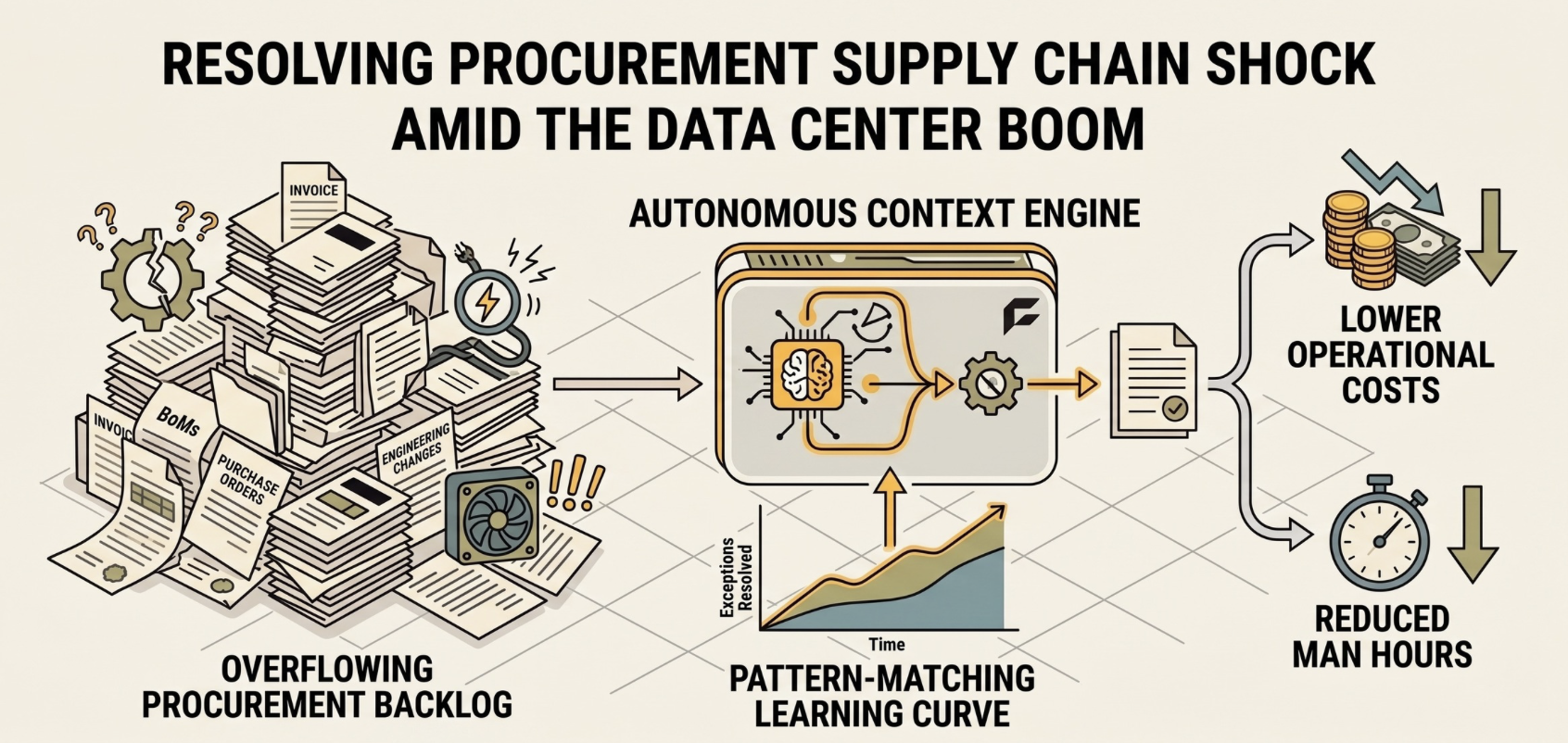
Meanwhile, inside the average AP queue, the picture is pretty consistent. Ardent Partners found that 51% of companies say invoice exceptions are their number one challenge. Top-performing AP teams still see a 9% exception rate, and the average is 22%. Over 60% of invoices still require some level of human interaction. Manual processing runs anywhere from $12 to $40 per invoice depending on the company.
Every one of those exceptions is a ticket. Every ticket is a person. Every person is revenue for someone. And rarely is that someone you.
The BPO contract you signed five years ago assumed some share of work would always require human judgment. The price per FTE bakes it in. The consulting firm you brought in to "transform" the function built a roadmap that preserves the queue, because the queue is where the billable work lives. The ERP vendor charges you more for every user who logs in to resolve an exception. Nobody in this arrangement wakes up in the morning wanting your exception rate to hit zero. If it did, everyone in the room would have less business tomorrow than they had today.
This is the pattern worth noticing. The people you pay to fix your procurement process are the same people whose revenue depends on you continuing to have a process worth fixing.
What changed
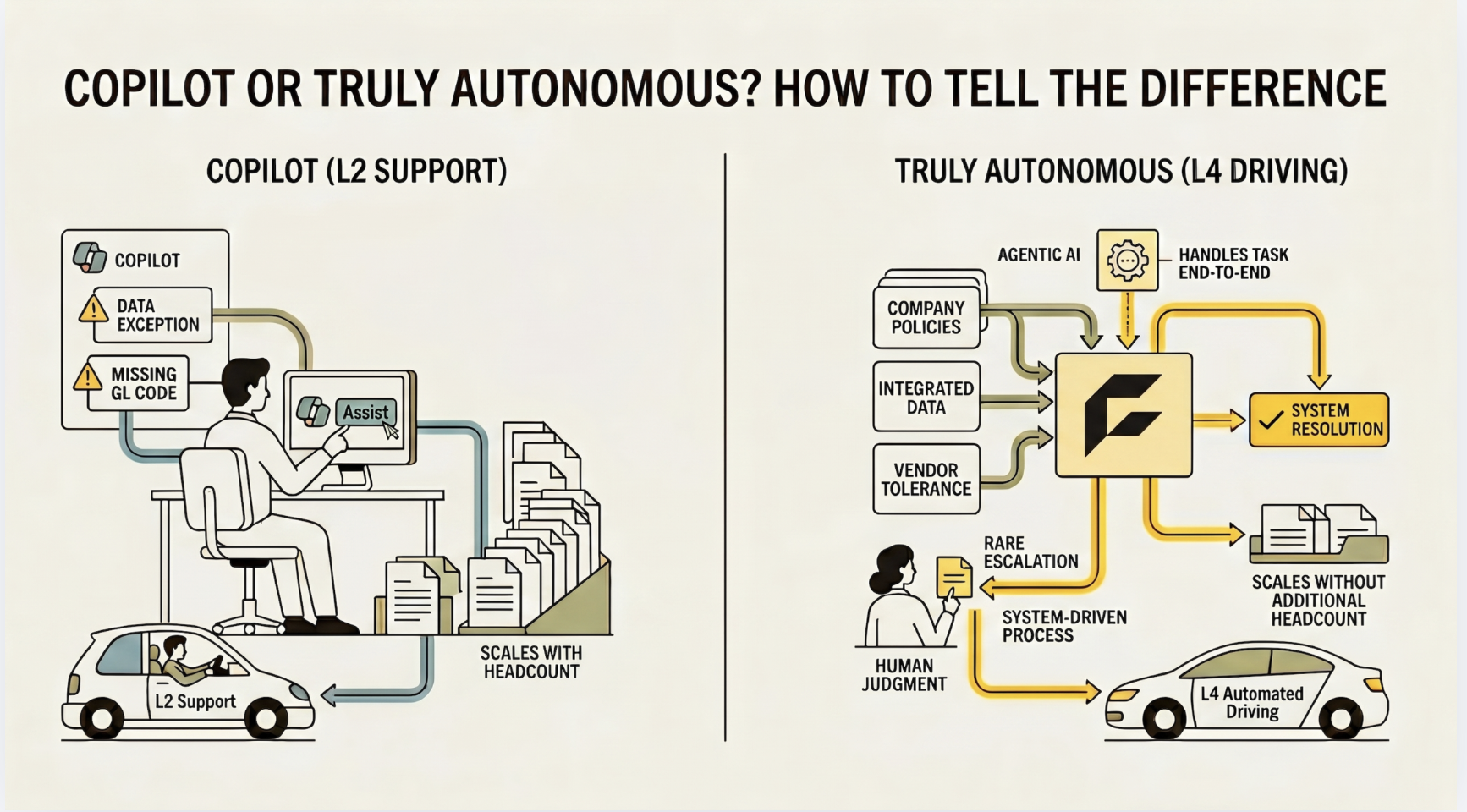
For a long time this was fine, because there wasn't really an alternative. Previous waves of automation software handled the easy 80%. RPA could scrape a PDF. OCR could pull line items. Three-way match could clear the clean invoices. But the exceptions were another thing entirely. A missing PO. The wrong GL code. A vendor name that doesn't quite match. A line item you have to call a buyer to explain. Those needed judgment. Judgment meant people. And people meant the BPO.
What's changed is that AI is now capable of the judgment part. Not just the extraction, not just the match, but the actual reasoning an AP clerk applies when they look at a weird invoice and decide what to do with it. The work that has kept the BPO industry staffed for two decades is work that software can now do.
Which raises the obvious question. If exceptions can actually be resolved by software, why would you keep paying per head to resolve them with humans?
A different model
What if there was a vendor whose business model was built in alignment with yours? One that got paid when your process got better, not when it got worse. One that had no reason to preserve a queue, because the queue was where it was most vulnerable.
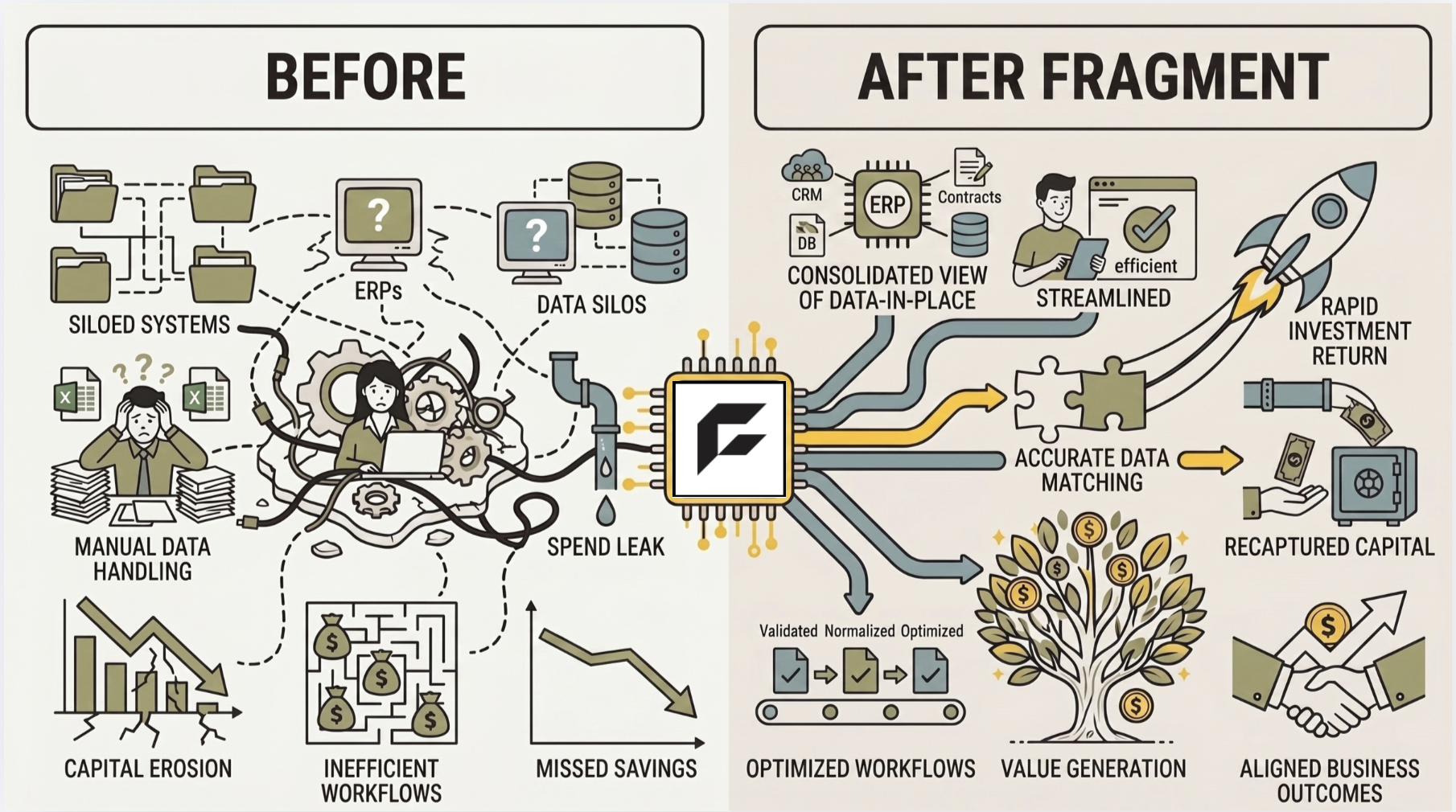
Imagine a model that looks genuinely different from what most procurement teams are used to today. No per-seat pricing that climbs every time a new analyst has to touch an exception, no forward deployed engineer army billing against a multi-quarter implementation, and no recurring fees for maintenance work that should have been handled by the software in the first place. Value priced against outcomes instead of inputs, with the underlying technology actually resolving exceptions rather than routing them somewhere else behind a prettier interface.
The counter-positioning that follows is pretty straightforward. Your BPO charges per head. Your consultants bill by the hour. Your software vendor sells more seats when more people touch exceptions. A vendor whose revenue goes up when your exceptions go down is structurally the only kind of partner on your side of the table.
If you run a GBS organization, a procurement function, or a finance org that still has a queue of exceptions moving through a BPO contract, the math has changed. The question isn't whether AI will eventually handle this work. It already can. The question is whether you want to keep paying for the old model while the new one is already running.
That's what we built Fragment to do. If you're weighing this decision right now, we'll show you what autonomous exception resolution looks like on your actual data.