

AP automation ROI: how to measure it honestly, agents included

AP automation ROI is the verified return an accounts payable automation program earns against its full cost, measured from a baseline captured before the project starts: the fully loaded cost per invoice (all labor, systems, and overhead divided by annual volume), the early-payment discount capture rate, and the error leakage rate. Gains count when they can be checked against ledger evidence – touches eliminated, discounts taken, duplicates stopped, a faster close. A return claimed against a baseline nobody measured is fiction.
This wiki writes its source-to-pay definitions for companies where AI agents carry the operational load – matching invoices, coding lines, working exception queues – and people keep the approvals and the judgment calls. Most treatments of AP automation ROI read as vendor spreadsheet exercises; this page treats it as a measurement discipline a CFO can audit, and one that agents reshape.
The baseline is measured before the contract is signed
Every credible AP automation ROI model starts with a number most teams have never computed: the fully loaded cost per invoice. Take everything AP consumes in a year – loaded salaries of everyone who touches invoices, the capture tool, workflow licenses, the allocated share of the ERP's AP module, the finance overhead behind the function – and divide it by annual invoice volume. Most teams know only the labor line, and vendor models fill the gap with benchmarks that describe someone else's invoice file.
Two companion numbers complete the baseline. The discount capture rate is the share of offered early-payment discounts the company actually takes, computable from invoice terms and payment dates. Error leakage is the money that leaves through duplicates and overpayments, usually visible only in the last recovery audit's findings. The case for AP automation stands or falls on these three pre-project measurements, and the same rule anchors the procurement automation business case upstream. Measure first, sign second.
Four gains are real, and each can be audited
Once the baseline exists, the return is a short ledger, and every line has a verification method.
- Touches eliminated. A touch is any human action an invoice needs on its way to posting: keying, coding, an approval chase, a hold review. Count touched invoices and the minutes they absorb before the project, remeasure the same way after, and price the difference at the loaded hourly rate. Touchless invoice processing – an invoice that posts and pays with zero human actions – is the end state, and system activity logs make the touch count checkable rather than estimated.
- Discounts captured. The terms are printed on the invoice ("2/10 net 30": a 2% discount for payment within ten days, full amount due in thirty) and capture shows up in the payment record. It is the easiest gain in the model to audit, which is why it should anchor the case.
- Leakage stopped. A duplicate or overpayment blocked before the payment run is recovered cash, verifiable in blocked-payment logs and supplier credit memos. Recovered dollars are real dollars; no conversion assumption is needed.
- Close accelerated. Measure this as the count of invoices requiring an accrual – an estimate booked for a cost incurred but not yet posted – at month-end close. Fewer accruals mean fewer estimates to defend and fewer true-ups the following period.
Double-counting inflates the AP automation ROI case
Inflated business cases usually share one flaw: the same dollar counted twice. Four traps do most of the damage.
- Soft minutes at full conversion. "Fifteen minutes saved per invoice" multiplied across ninety thousand invoices produces an impressive figure while every person involved remains fully busy. Time savings convert to money at well under one hundred percent; an honest model states its assumed conversion rate.
- Capacity freed to nowhere. Freed hours count when they redeploy to named work with an owner – statement audits, credit and deduction recovery, discount term management. Capacity with no written destination gets claimed at zero.
- One gain, two vendors. The capture vendor claims the invoice that went touchless, and the workflow vendor claims the same invoice again; a two-vendor stack can claim well over one hundred percent of a single improvement. Assign each invoice's gain to exactly one line.
- Benchmark manual costs. Benefits computed against an industry cost per invoice several dollars above your measured one inflate every line downstream. Compute against your own baseline only.
Year-two assumptions are where these traps surface, usually in the form of the disappointing deployments cataloged in where AP automation stalls.
A worked model shows what honest arithmetic looks like
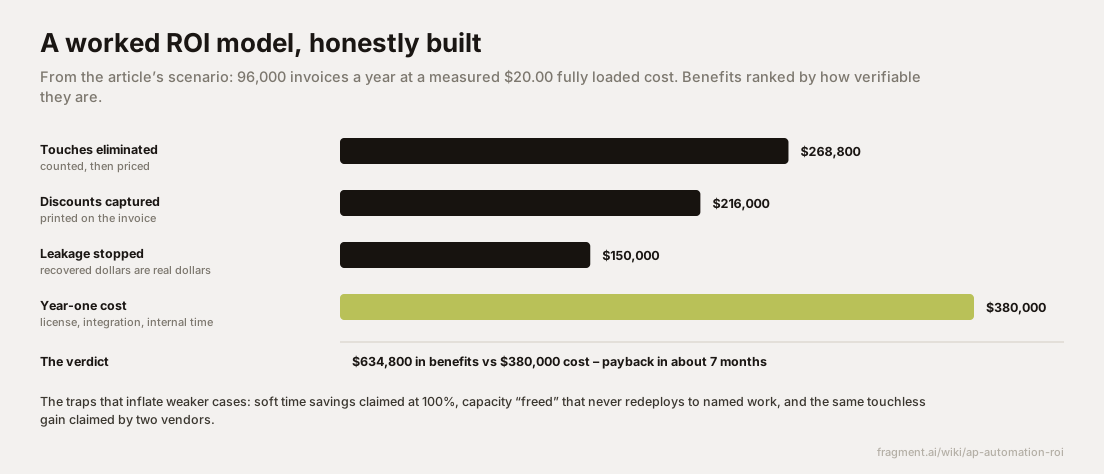
Take a manufacturer processing 96,000 invoices a year. Pre-project, AP's full cost pool is $1,920,000 – $1,310,000 in loaded labor, $340,000 in systems (capture, workflow licenses, the ERP module allocation), $270,000 in allocated overhead – so the baseline is $20.00 per invoice. 57,600 invoices need at least one touch, averaging 20 minutes each: 19,200 hours of touch work. Suppliers offer 2/10 net 30 on $18,000,000 of spend, so $360,000 is available and $54,000 gets captured. Last year's recovery audit found $210,000 in duplicates and overpayments after the money was gone.
Year one after automation: touched invoices fall to 24,000 at the same 20 minutes, freeing 11,200 hours. At $48 loaded per hour that is $537,600 of capacity, and the model claims half – $268,800 – because only half is redeployed to named recovery and discount work. Discount capture rises to $270,000, a $216,000 gain verified payment by payment. Pre-payment blocks stop $150,000 in duplicates before the cash leaves. Accruals at close fall from 1,900 open invoices to 400, reported unpriced. The claimed total is $634,800 a year against an all-in program cost of $380,000, for payback in just over seven months, with every line traceable to a record.
Agents move the return into the exception queue
AI agents change where AP automation ROI concentrates, because they work the most expensive invoices in the building: the exceptions, invoices that fail a validation check – a price off the purchase order, a quantity above the goods receipt – and drop into a human queue. At the model's $48 rate, an exception consuming 45 analyst minutes carries $36 of labor before any systems cost is allocated, against a $20.00 all-in average; the cost of invoice exceptions runs at several multiples of the average invoice. A per-invoice average dilutes agent gains into invisibility.
Measure agents on two numbers instead. Cost per resolved exception divides the queue's labor and systems cost by cases closed; agents working the tail should collapse it. Aging collapse tracks the median days a hold stays open, the figure that decides whether discount windows survive the queue. Verification uses the zero-touch case count defined by the autonomous exception resolution test: a case counts only when the agent closed it end to end, evidence attached, with no human minutes logged. Sampling those case files quarterly keeps the count honest.
The quarterly ROI review fits on one page
A CFO should demand one page each quarter: cost per invoice computed exactly as the baseline was, touched-invoice count and minutes, discount dollars offered and captured, leakage blocked, cost per resolved exception, zero-touch case count, and program cost to date. Same definitions every quarter, and each number names its verification source. Any line that cannot name one comes off the page. The page stays short because every number on it has already survived an argument.
Fragment builds AI agents for the queue where this measurement bites hardest – three-way match failures, duplicates, GL coding, credits and deductions – working inside the SAP or Ariba environment a company already runs, with people approving the judgment calls. Every case an agent closes carries its evidence file, so the zero-touch count on the quarterly page is an export rather than an estimate. See the workflows Fragment automates or book a demo.