

Touchless invoice processing: the pipeline, and where agents extend it

Touchless invoice processing is the handling of a supplier invoice from arrival to scheduled payment with no person involved at any point. The invoice is received, its data captured, the supplier and purchase order verified, the amounts matched against the order and the goods receipt, the expense coded to the general ledger, and the payment queued, all by machine. A single failed stage anywhere in that sequence drops the invoice into an exception queue, and once a person opens it, the invoice has left the touchless count for good.
This wiki covers source-to-pay vocabulary for operations where AI agents carry the working layer – reading documents, matching records, chasing down mismatches – and people keep the sign-offs and judgment calls. Most glossaries treat touchless processing as a KPI to report upward. This page treats it as a pipeline to engineer, stage by stage, including the final stretch that agents have recently made automatable.
Touchless invoice processing is a gauntlet, and every stage must pass
An invoice earns touchless status by surviving six stages in a row. Each one has a specific job, and each one can end the run.
- Arrival channel. How the invoice shows up decides how hard everything downstream will be. E-invoicing – the exchange of invoices as structured data, such as EDI 810 transactions or Peppol XML, sent system to system with no document for software to interpret – arrives with every field already populated and reliable. A PDF emailed to the AP inbox arrives as pixels that something has to read. Paper arrives needing a scan before the pixels even exist. The same invoice content carries very different odds depending on which door it came through.
- Capture and extraction. Header and line data have to come off the document: supplier name, invoice number, date, currency, PO reference, line quantities, unit prices, tax. The mechanics are covered on the OCR invoice capture page. What this stage must get right is fidelity on every field, because a misread unit price sails through here and fails the match two stages later, turning a capture error into a phantom price dispute.
- Validation. Before any matching, the system checks that the invoice belongs in the process at all: the supplier resolves to an active vendor master record, the PO reference points to a real, open purchase order, and the invoice fails no duplicate check against supplier, invoice number, and amount already in the ERP. An invoice that names "Acme Industrial LLC" when the vendor master says "Acme Industrial Supply Inc." stalls right here.
- The three-way match. The system compares the invoice line by line against the purchase order and the goods receipt, the warehouse record confirming what actually arrived. Three-way matching has its own page; the requirement for a touchless run is that every line agree on price and quantity within tolerance, the variance band the company accepts without review, such as 2% on price.
- Automated GL posting. The matched invoice needs an account assignment. PO-backed invoices inherit coding from the PO lines; the posting then clears any rule-based approval, such as auto-release below a dollar threshold, and books to the ledger in SAP or whatever ERP is on the floor.
- Scheduled payment. Payment terms apply, any early-payment discount window is calculated, and the invoice joins a payment run. Only when the run executes has the invoice finished untouched.
The yield is multiplicative, which is why good stage rates still bleed
Because every stage must pass, the pipeline's touchless yield is the product of the stage pass rates. Take a cohort of 1,000 invoices through plausible rates; the figures are a scenario, and the arithmetic is the point. Capture extracts 92% cleanly, leaving 920. Validation passes 95% of those, leaving 874. The three-way match clears 88% within tolerance, leaving 769. Coding and rule-based approval pass 97%, leaving 746. Payment scheduling holds 98%, and 731 invoices finish untouched.
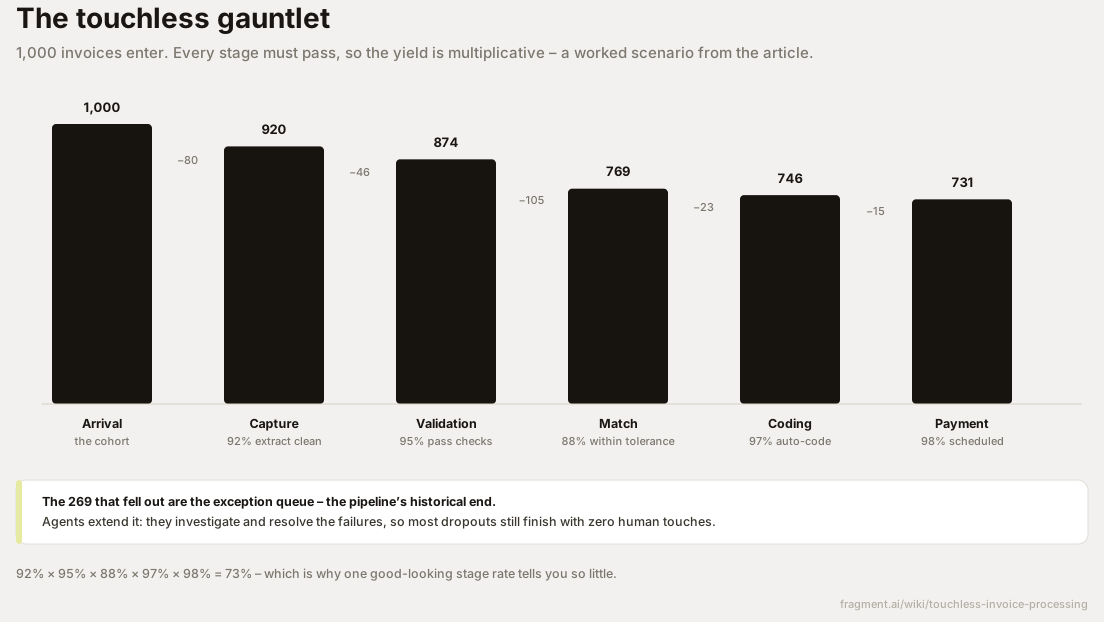
Every stage posted a number its vendor would happily put on a slide, and the pipeline delivered 73%. This is why a headline like "90% capture accuracy" tells you so little on its own: even a stage that good surrenders a tenth of the cohort immediately, and the survivors still face four more gates. The effect is sharper when accuracy is quoted per field, since an invoice is only touchless-eligible if every one of its fifteen or so extracted fields is right, and per-document accuracy always runs below the per-field figure printed in the brochure.
What breaks the run is the exception population
The 269 invoices that fell out of the cohort are invoice exceptions: price variances above tolerance, quantities billed over what was received, missing or invalid PO references, suspected duplicates, unreadable or misextracted lines. How large that population runs in practice, and how it varies by industry and invoice mix, is the subject of the invoice exception rate benchmarks page. Each one lands in a queue where a person establishes what went wrong, which is exactly the touch the pipeline exists to avoid.
AP programs have two classic responses. The first is widening match tolerances, reclassifying near-miss failures as passes by policy. It works instantly and it carries an honest trade: a band widened from 2% to 5% on price converts genuine overbilling into auto-approved spend along with the innocent variances, and the leakage is silent, recurring, and invisible in the touchless number it just improved. The second is supplier enablement, moving suppliers from PDF and paper onto e-invoicing or a portal so more volume enters through the clean channel. This one genuinely raises stage-one and stage-two quality, and it moves slowly: the large suppliers who adopt first were already the cleanest senders, while the long tail of small suppliers, where the messy documents originate, rarely converts.
Agents extend touchless invoice processing past the match
Historically the pipeline ended at the match. Whatever failed a check became a person's job: read the hold, pull the PO, email the buyer or the supplier, decide. AI agents extend the pipeline through that stretch by running the investigation themselves. An agent picking up a price-variance failure pulls the contract pricing schedule, checks whether a rate adjustment explains the invoiced figure, reviews how the last identical mismatch was resolved, and either posts the invoice with a documented rationale or routes it to a person with the evidence attached. A suspected duplicate gets checked against payment history instead of a shared inbox. A misextracted line gets re-read against the source document and corrected. The manual vs automated exception resolution page walks the two paths side by side.
That extension changes what the failure population costs, since most of the 269 dropouts in the cohort above can now finish without a person opening them. It also raises a definitional wrinkle worth one line: an invoice investigated by an agent was worked, yet no human touched it, and the touchless rate's value page takes up what that does to the metric.
Fragment builds the agents that run this last stretch, resolving the invoices that fail capture, validation, or the match inside your existing SAP or Ariba environment, with no rip and replace. See how the workflows run or request a demo.