

What a point of touchless rate is worth, and how agents move it

The touchless rate is the share of supplier invoices that travel from receipt to posting with zero human touches: no re-keying, no hold-queue investigation, no approval reminders. An invoice counts as touchless only when systems carry it the whole way; the moment a person opens it, corrects it, or chases it, it joins the touched column. The rate earns its attention because it converts to dollars by plain arithmetic – every touched invoice carries a labor cost that an untouched one does not.
This wiki defines procurement and AP terms for companies where AI agents carry the operational load – matching invoices, coding lines, investigating holds – while people keep the judgment calls. A standard glossary stops at defining the touchless rate; this page prices it, one point at a time, and then asks which points an agent can actually move.
A touchless rate is only as honest as its denominator
Pin the definition down before doing any arithmetic, because the metric is measured loosely. Some teams compute their touchless rate on PO-backed invoices only, leaving non-PO spend out of the denominator. Some start the clock after capture, so an invoice a clerk re-keyed from a PDF still counts as untouched. Each choice inflates the headline number. For this page, touchless means zero human minutes anywhere between receipt and posting. What published figures are actually counting is taken apart in invoice exception rate benchmarks, and the pipeline that produces a touchless invoice – e-invoicing, capture, matching, automated posting – is laid out in touchless invoice processing.
Price the touch before you price the point
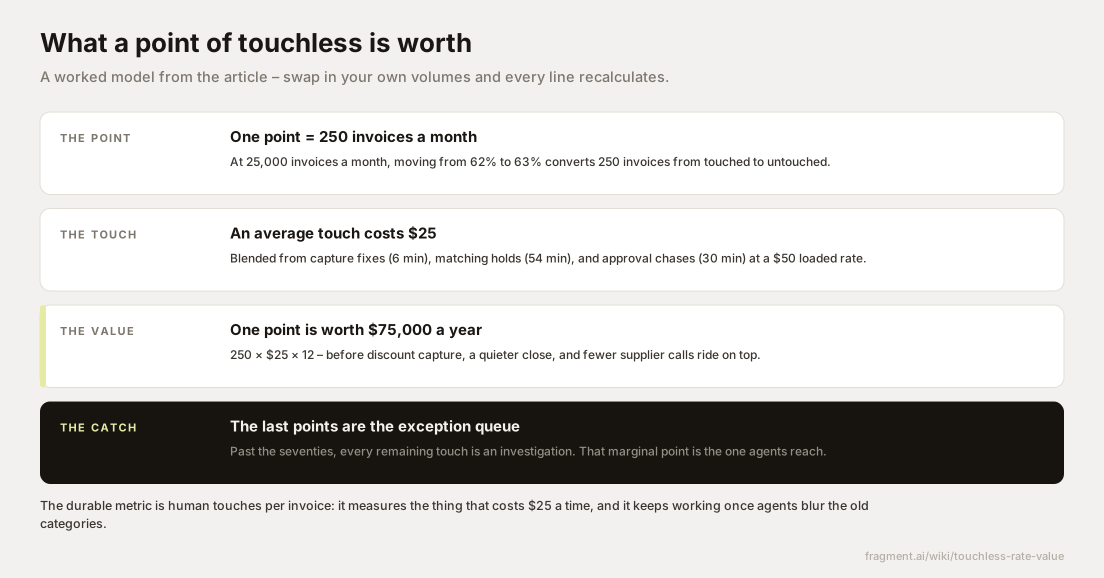
Take a company processing 25,000 invoices a month at a 62% touchless rate. Each month 15,500 invoices post with zero human minutes and 9,500 collect touches. To price a point, first price a touch from its own components:
- Capture fixes. Around 40% of the touched invoices need a person to correct what optical capture misread or a supplier left out – a mangled PO number, a missing tax field. The work is quick; call it 6 minutes each.
- Matching holds. Another 40% fail the three-way match, the line-level comparison of invoice against purchase order and goods receipt, and land in a queue for investigation. Someone pulls the PO history, emails the buyer, checks whether the variance sits inside tolerance (the band a company allows before requiring review), and decides. Cumulative effort per invoice: call it 54 minutes.
- Approval chases. The remaining 20% clear their checks but stall on a person – an approver on vacation, a cost-center owner who ignores three reminders. The chasing consumes about 30 minutes of AP time per invoice, spread across a week.
Blend those shares and the average touched invoice absorbs 30 minutes of person time. At a $50 fully loaded hourly rate – salary, benefits, and the systems and overhead behind the desk – a touch costs $25, while an untouched invoice rounds to zero human cost. The touched workload therefore runs 9,500 × $25 = $237,500 a month, or $2.85 million a year. That figure is the ceiling on what touchless improvement can recover; the same decomposition, run at full depth, is the exercise in the cost of invoice exceptions.
What is one point of touchless rate worth?
One percentage point of this company's volume is 250 invoices a month. Moving from 62% to 63% converts 250 invoices from touched to untouched: 250 × $25 × 12 = $75,000 a year, recurring for as long as the point holds. Ten points recovers $750,000 of the $2.85 million.
The labor line is the floor, because a touched invoice is also a slow invoice. Suppose one in ten of those 250 converted invoices carries a 2/10 net 45 early-payment discount (2% off for payment within ten days) on an average value of $8,000. Cleared in a day, each captures $160; parked twelve days in a matching hold, each misses the window. That is 25 × $160 = $4,000 a month riding on the same point. Month-end close gets quieter too: every invoice still on hold at close becomes an accrual entry someone estimates, books, and reverses, while a converted invoice simply posts. And a held invoice generates "where is my payment" emails and calls from the supplier, each of which is a touch the model above never counted.
The first points are cheap and the last points are the exception queue
The cost of buying a point rises as the rate climbs. A company at 45% gets its first points from mechanical work: moving its top hundred suppliers to e-invoicing (structured invoices submitted machine to machine, skipping capture entirely), retraining capture templates, filling gaps in the vendor master. Those points come fast and cheap.
Past the seventies the easy failures are gone, and nearly every remaining touched invoice is an invoice exception: it failed matching or validation for a reason that requires investigation – a price that disagrees with the contract, a goods receipt that was never posted, a unit-of-measure mismatch between the PO and the invoice line. The gap between the touchless rate and 100 becomes the exception queue expressed as a percentage. Capture tools, workflow engines, and e-invoicing portals bought the early points and have nothing to offer an invoice whose resolution requires reading a contract clause. This is why touchless programs stall in the seventies and eighties: the marginal point turned from an automation problem into an investigation problem.
Agents change which points are reachable
Resolution agents work the stalled segment directly. An agent picks up a matching hold, pulls the PO history from SAP, reads the pricing clause in the supplier's contract, checks receiving records, and either posts the invoice with a documented rationale or escalates it with the investigation attached – the difference detailed in manual vs automated exception resolution. When the agent carries a hold end to end, the invoice reaches posting with zero human minutes.
Which raises a definitional wrinkle the metric was never built for. If an agent investigated an invoice for eleven minutes and a person never saw it, was it touchless? Under the definition this page uses – zero human touches – yes. Under a stricter reading, where touchless means the invoice needed no investigation at all, no. Companies adopting agents should decide explicitly which version they report, because the two diverge as soon as agents start clearing holds. The durable metric is human touches per invoice: it measures the thing that costs $25 a time, it keeps working when agents blur the old categories, and it resists the denominator games that flatter the headline rate.
Instrument touches, cost per touch, and concentration
Three instruments make the model live in your own operation. First, touches per invoice: count every human interaction with an invoice across the full population, divide, and track it monthly. Second, cost per touch: recompute the blended minutes and loaded rate from your own data yearly, because the $25 above is scenario arithmetic and yours will differ. Third, concentration: rank the remaining touches by supplier, failure reason, and plant. Touches cluster hard in practice – a handful of suppliers with chronic price-file drift, one plant that posts goods receipts late – and the concentration report is a ranked to-do list for buying the next point at the lowest cost. The touchless rate summarizes the program; these three numbers tell you where the next $75,000 sits.
Fragment builds AI agents that move the stalled points on this curve: they investigate and resolve the matching holds and validation failures that keep invoices in the touched column, inside a company's existing SAP or Ariba environment with no rip and replace. Each hold an agent clears end to end converts at exactly the arithmetic above. See how the workflows run or request a demo.