The math of private equity has changed. McKinsey states entry multiples hit 11.8x EBITDA in 2025, the highest on record. Leverage as a share of deal structure has fallen from 44% to 37% over the last decade. Hold periods have stretched to six years on average. The era of buying cheap, levering up, and riding multiple expansion to a profitable exit is over.
Bain & Company's 2026 Global Private Equity Report frames this bluntly: deals today demand faster EBITDA growth than at any point in the last two decades. Operational improvement has displaced financial engineering as the primary value creation lever, with revenue growth driving 71% of value created in 2024 exits. For operating partners and portfolio leadership teams, returns now come from making companies run better. And among all the operational levers available, procurement remains one of the fastest and most measurable paths to EBITDA impact.
Procurement Is the Lever. So Why Hasn't It Worked?
The opportunity is well documented. Accenture's research finds that strategic procurement improvements can deliver 8 to 12% cost reduction on direct and indirect spend, often in months. For a portfolio company with $230M in procurement spend, Efficio illustrates how that can generate $77M to $115M in enterprise value at current EBITDA multiples. Investments where procurement is identified early as a value creation opportunity are 70% more likely to capture significant value, according to Accenture.
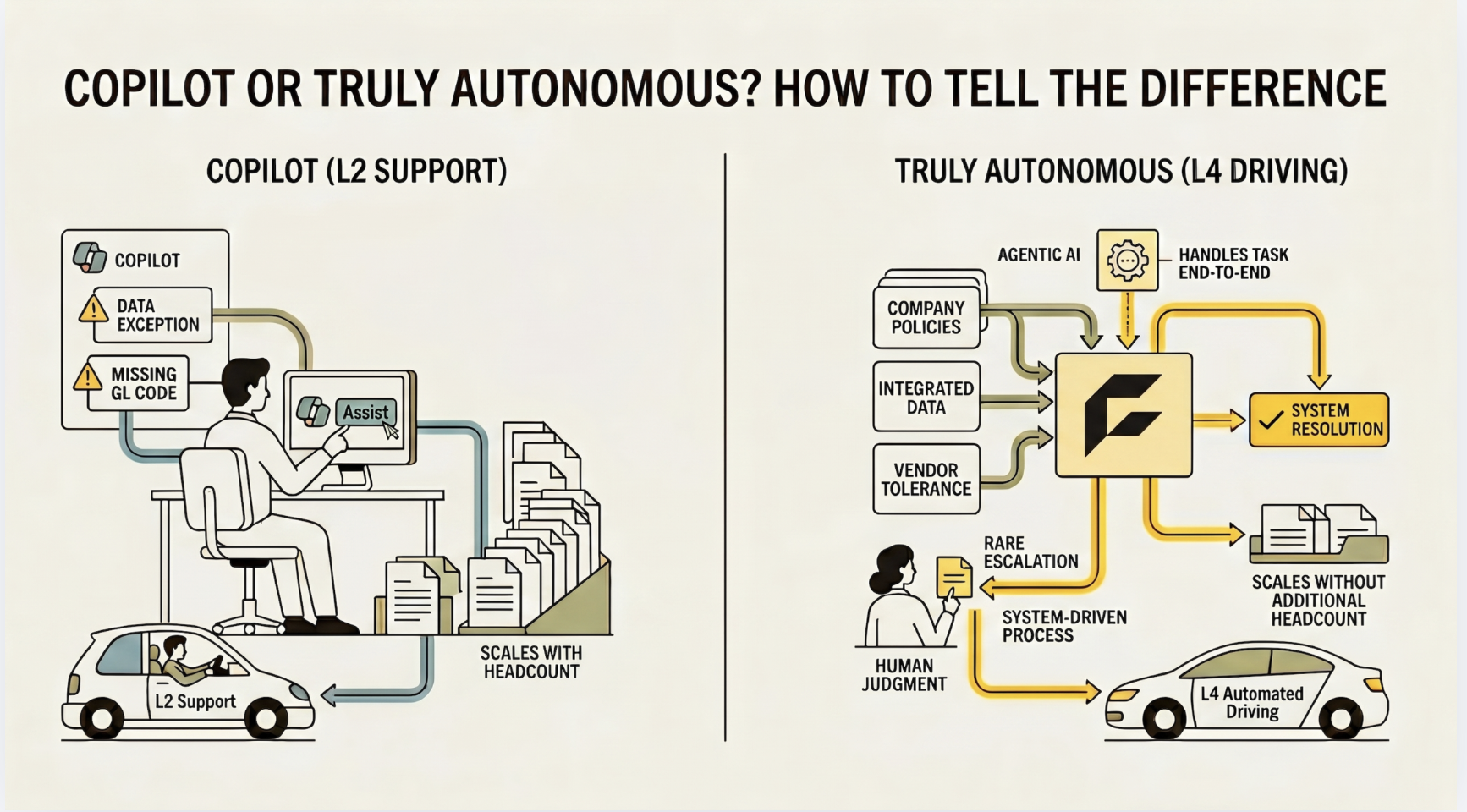
Most PE firms prioritize procurement within the first 100 days. The early wins come fast: renegotiated contracts, rationalized tail spend, volume-based discounts. Then progress stalls. It stalls because the biggest source of ongoing operational cost is not supplier pricing. It is the volume of manual exception handling, reconciliation, and cross-system rework that consumes procurement operations teams across every portfolio company. This is the cost that persists long after the consultants leave. And it is the cost that virtually no procure-to-pay technology in the market was designed to eliminate.
Three Structural Problems
1. The technology can't see across the full operation
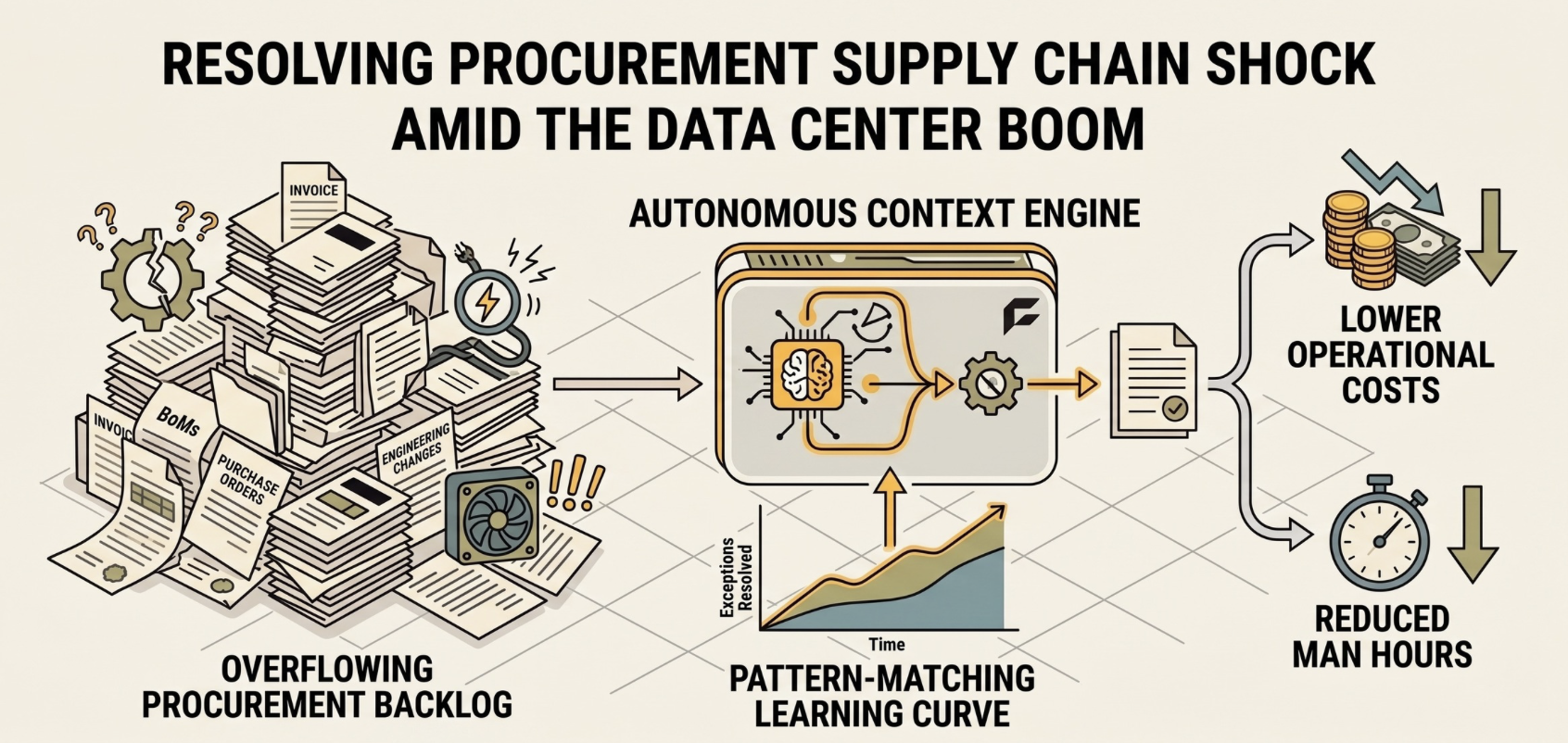
Ardent Partners' 2025 benchmarks put the industry-average invoice exception rate at 22%. Even top performers carry a 9% rate. These exceptions exist because procure-to-pay technology was never designed to reason across systems. A three-way match fails because the supplier shipped 480 units against a PO for 500. A contract price doesn't match the ERP because terms were renegotiated and never updated. Resolving any of these requires a human to open multiple tabs, cross-reference data, and manually push the process forward. McKinsey estimates procurement functions use less than 20% of available data, even as spend managed per employee has grown 50% in five years. The data exists across these systems. But procure-to-pay platforms were built to operate within a single system, not reason across all of them. That architectural limitation is why exceptions persist.
2. Deployment timelines don't match PE hold periods
Traditional procure-to-pay platform implementations take 12 to 18 months before they are operational, and another 6 to 12 months before ROI materializes. For a PE-backed company with a six-year hold period, that means the technology may not deliver meaningful automation until year two or three. The implementation consumes internal resources, creates change management friction, and demands organizational bandwidth during a period when every month of performance feeds directly into exit valuation.
3. Everyone in your procurement ecosystem profits when the problem persists
The global BPO market exceeded $325 billion in 2025. Finance and accounting outsourcing alone, which includes the procure-to-pay work that drives exception handling, exceeds $50 billion and is growing at over 9% annually. Your BPO charges per head. Your consultants bill by the hour. Your software vendor sells more seats when more people touch exceptions. Every player is commercially incentivized to maintain the status quo. For PE firms managing procurement across a portfolio, this incentive problem compounds. The aggregate spend on managing the operations gap is enormous, and none of it is structured to decrease over time.
The Structural Shift
McKinsey's 2025 research on agentic AI in procurement projects that the technology could make procurement functions 25 to 40% more efficient, with enterprises already reporting 20 to 30% gains in staff efficiency. But those gains only materialize if the technology can reach the work that matters: the exceptions that drop into manual queues. That is where headcount concentrates. That is where BPO spend accumulates. That is where EBITDA improvement lives.
Introducing Fragment: Procure-to-Pay Automation Built for PE Timelines
Fragment was built to resolve the exceptions that every prior generation of procure-to-pay technology left for humans, across every system in the operation. Here is how it addresses each structural problem directly.
Your entire operation's knowledge, available on every transaction
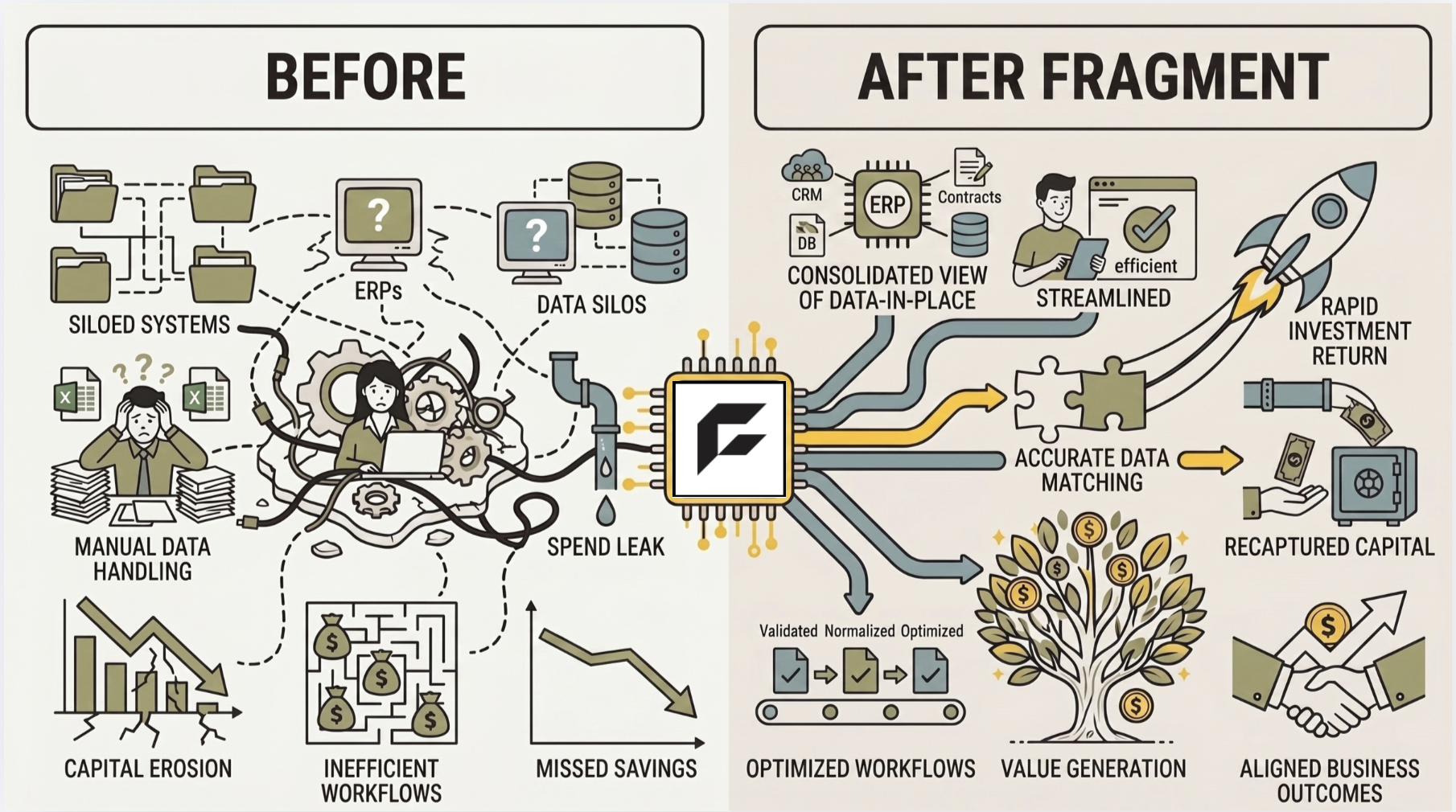
Fragment's proprietary technology, the Autonomous Context Engine (ACE), builds a semantic understanding of how data relates across every system a portfolio company runs: ERP, supplier portals, contracts, email, spreadsheets, legacy tools. The ACE learns policies, abbreviations, and institutional shortcuts. It connects to structured and unstructured data across every source and reasons over it in place, without requiring data to move into a new platform.
The ACE does for procurement operations what a Bloomberg terminal did for capital markets. Bloomberg didn't replace data sources. It sat on top of all of them and made the data instantly usable. The ACE does the same thing across a procure-to-pay stack. For PE firms, this means Fragment works with whatever technology stack the portfolio company already has, regardless of how fragmented or legacy it may be.
Deployment in hours, not months
Fragment connects to existing systems without replacing anything. No data migration. No IT project. Deployment happens in hours, ROI begins in days. Fragment can be introduced during the first 100 days alongside sourcing initiatives and deliver measurable automation before those initiatives finish their first cycle. Across a portfolio, this speed compounds. Multiple companies can be deployed simultaneously without dedicated project teams or change management programs.
Fragment only makes money when your exception volume drops
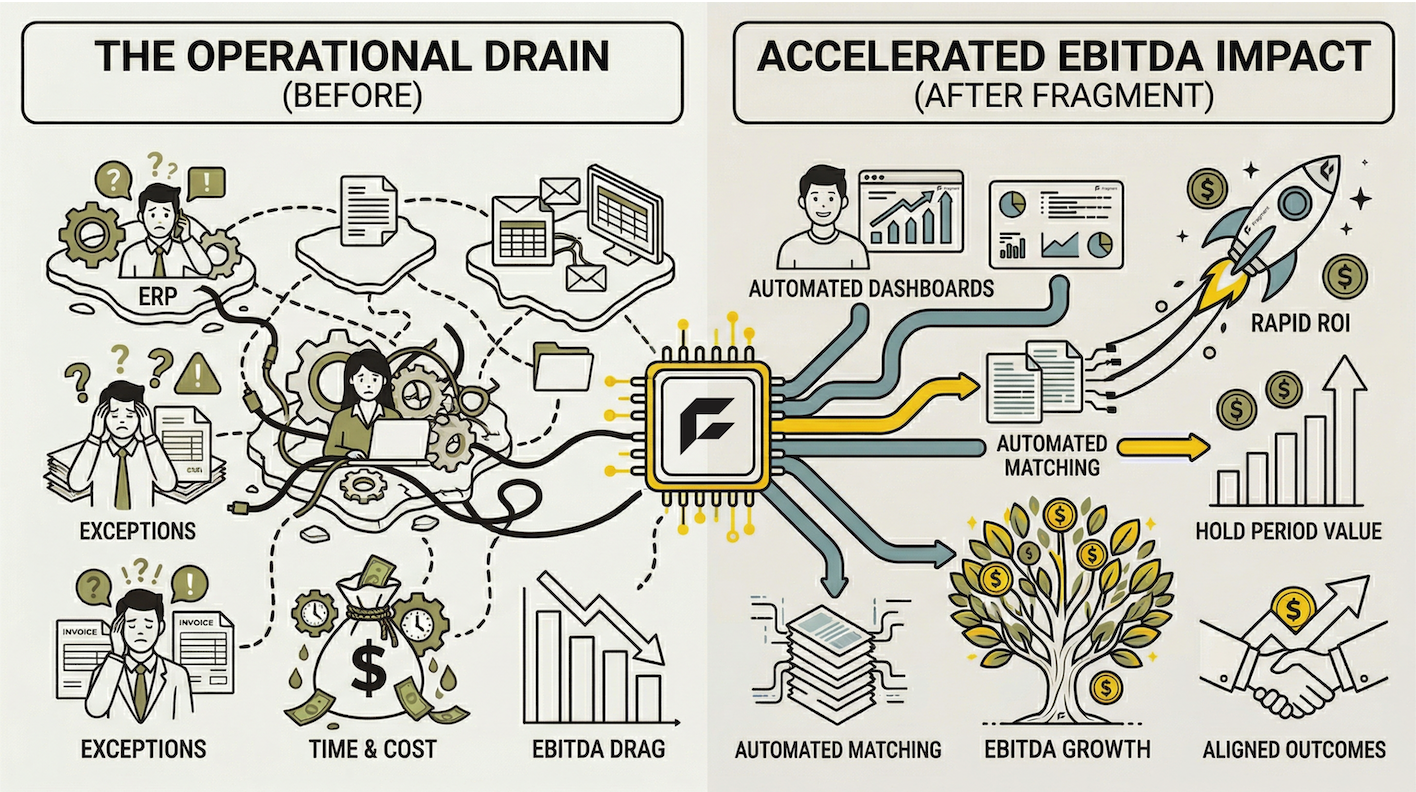
There is no per-seat pricing. There are no implementation fees. There is no deployment project and no risk to get started. You pay for outcomes. Instead of each portfolio company running its own BPO contracts, platform licenses, and consulting engagements, a PE firm can deploy Fragment on a commercial model structurally aligned with value creation. As exception volume drops, costs drop. As automation expands, the returns flow directly to EBITDA.
Fragment is the only vendor in the procurement ecosystem whose incentives are structured to match yours.
What This Means for Your Portfolio
Sourcing renegotiations and spend consolidation were the first chapter of procurement value creation. The new opportunity is automating the operational work that persists year after year: the exception handling, the manual matching, the cross-system reconciliation that sustains BPO headcount and quietly erodes EBITDA across every hold period.
Fragment eliminates that work. It deploys on PE timelines. It works with whatever systems are already in place. And it charges for results, not effort.
If you are an operating partner, a portfolio CFO, or a value creation leader looking for procurement impact that goes beyond one-time savings, that is exactly what we cover in a first conversation.